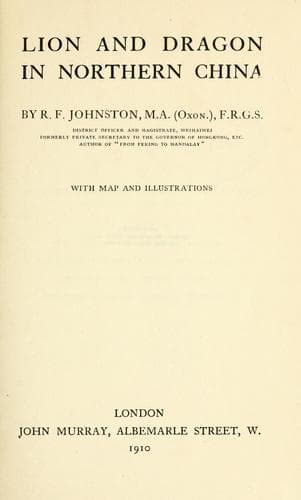
Lion and Dragon in Northern ChinaJohnston, Reginald Fleming, Sir
History
Lion and Dragon in Northern China
Johnston, Reginald Fleming, Sir
Weihai (China) -- History; Weihai (China) -- Social life and customs
But such regrettable incidents are rare in rural China. It is true
that marriage is hardly ever preceded by love-making, and that young
people have as a rule absolutely no say in the important matter of
the choice of a husband. Yet the women of the farming classes in a
rural district such as Weihaiwei are by no means concealed from public
view; if a young man does not catch a sight of his betrothed at some
village festival or a theatrical performance he is sure to have many
opportunities of beholding her at work in the fields at harvest time or
washing clothes at the side of the local brook. Sometimes, indeed, the
young couple grow up together in the same household almost like brother
and sister. This happens when, after child-betrothal has taken place,
the girl's parents die or are too poor to keep her. She then passes to
the bridegroom's family and is theoretically supposed to be brought up
as a daughter of the house, though sometimes she is treated as a mere
servant or drudge. Such a girl is known as a _t'uan-yüan hsi-fu_. As an
orphan, or the daughter of poor or helpless parents, she is expected to
cultivate a more than usually meek and respectful demeanour towards the
parents of her betrothed, and to be "thankful for small mercies." When
the boy's parents (for the boy himself has no say in the matter) decide
that a fitting time for the marriage has arrived, it is customary for
the girl to be sent temporarily to the care of some relative, where
she remains until the wedding-day. This is in order that in accordance
with the usual custom she may enjoy the privilege of being carried to
her husband's home in a red marriage-chair. In such a case as this the
bride and bridegroom are of course well acquainted with each other's
personal appearance and disposition, and have good reason to know,
before the wedding takes place, whether their married life is likely
to be a happy one. If the prospects are adverse, the bridegroom-elect
can only escape his doom by running away, for the betrothal cannot be
repudiated. The bride, poor child, has no choice in the matter one way
or another.
Public-domain text, read in full here on John Shaqi.
Reviews
Reviews
No reviews yet
Be the first to share your thoughts on this work.
Elsewhere in the archive
Join the Discussion
Join the discussion
Sign in to leave a comment or review.
Sign InorCreate an account