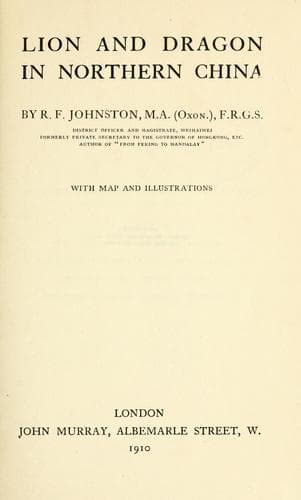
Lion and Dragon in Northern ChinaJohnston, Reginald Fleming, Sir
History
Lion and Dragon in Northern China
Johnston, Reginald Fleming, Sir
Weihai (China) -- History; Weihai (China) -- Social life and customs
In spite of the disparity of the dates of death the
ceremony was duly performed: thus a bride who had been in her grave for
more than a generation was wedded to a bridegroom who died thirteen
years before his own marriage.
In ordinary cases the repudiation of a betrothal contract while the
principals are both living is by law and custom visited by heavy
penalties. Paradoxical as the statement may appear, it is often
easier in China to get rid of a wife after the marriage ceremony has
taken place than to jilt her during the period of betrothal. There
is little or no romance about a Chinese engagement. The parents of
bride and bridegroom may or may not be known to each other; as a
rule they are strangers, for a girl is rarely married to a resident
in her own village. The reasons for this are not far to seek. As we
have seen, a typical Weihaiwei village is composed of persons of one
surname. The "prohibited degrees" in China are far more comprehensive
than those set forth in the English Book of Common Prayer. All
persons of the same surname are regarded as blood relations, and as
such they cannot intermarry. The father of a family must therefore
find husbands and wives for his children in some village other than
his own. In accordance with venerable custom, regular marriages are
negotiated neither by the parties chiefly concerned nor by their
parents. Betrothals are always in practice arranged through go-betweens
or middlemen (_mei jên_) who are understood to be the disinterested
friends of both the contracting parties. In return for their services
they receive various little presents and welcome invitations to sundry
little feasts.[165]
It is often declared that in China the bridegroom never has a chance of
seeing his bride or making her acquaintance until the fateful moment
when she raises her bridal veil: and many are the sad stories told
of the bitter disappointment of the girl who unexpectedly finds that
her husband is a decrepit old man, or the ardent young bridegroom who
suddenly realises that he is lord of an ugly or sour-faced wife instead
of the dainty beauty described by the deceitful go-between.
[Illustration: THREE WOMEN AND A HAYRICK (see p. 207).]
[Illustration: THREE GENERATIONS--AT THE VILLAGE GRINDSTONE
(see p. 246).]
Public-domain text, read in full here on John Shaqi.
Reviews
Reviews
No reviews yet
Be the first to share your thoughts on this work.
Elsewhere in the archive
Join the Discussion
Join the discussion
Sign in to leave a comment or review.
Sign InorCreate an account