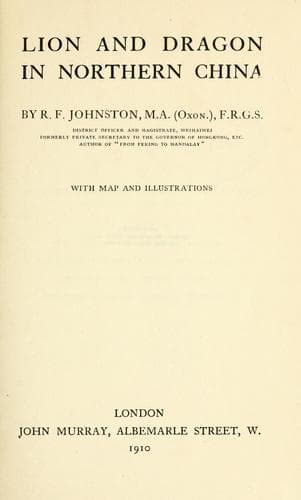
Lion and Dragon in Northern ChinaJohnston, Reginald Fleming, Sir
History
Lion and Dragon in Northern China
Johnston, Reginald Fleming, Sir
Weihai (China) -- History; Weihai (China) -- Social life and customs
[165] The custom of employing go-betweens is by no means exclusively
Chinese. It may be met with among races so far away as certain of the
tribes of British Columbia. (See Hill Tout's _British North America_,
p. 186.) For an ancient reference to the Chinese custom, see _Shih
Ching_, p. 157 (Legge).
[166] It is worth noting that it was not the husband who took the next
step but the husband's brother, by whom the woman had been brought
from Peking and who was held responsible by his brother and the clan
generally for her "success" as a family investment.
[167] By a peculiar fiction the children of a concubine are regarded as
the wife's children.
[168] See pp. 149 _seq._
[169] See pp. 149 _seq._
CHAPTER X
WIDOWS AND CHILDREN
The remarriage of a widow is, as we have seen, regarded in the
best circles with disapproval. The model wife--the wife to whom a
commemorative arch is erected on the roadside near her home and
whose name is handed down to posterity in the official chronicle of
her district as a pattern of virtue--is as scrupulously faithful
to her husband after his death as during his life. But very poor
families--such as are the majority of the families of Weihaiwei--cannot
afford to support widows for the mere joy of contemplating their
fidelity and chastity: hence we find that in practice a young widow
is often not only induced by her late husband's family to enter into
a second marriage and so rid them of the necessity of supporting her,
but is practically compelled to get married before the expiration of
the period of deep mourning, which lasts twenty-seven months. For a
widow to re-marry while in mourning for her husband is by Chinese law a
penal offence: though when the offence is committed on account of the
straitened circumstances of the widow and her first husband's family it
is generally allowed to pass without official notice or censure.
Public-domain text, read in full here on John Shaqi.
Reviews
Reviews
No reviews yet
Be the first to share your thoughts on this work.
Elsewhere in the archive
Join the Discussion
Join the discussion
Sign in to leave a comment or review.
Sign InorCreate an account