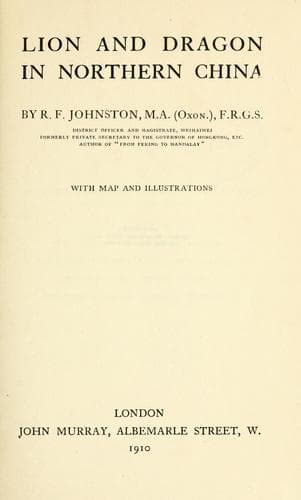
Lion and Dragon in Northern ChinaJohnston, Reginald Fleming, Sir
History
Lion and Dragon in Northern China
Johnston, Reginald Fleming, Sir
Weihai (China) -- History; Weihai (China) -- Social life and customs
If a young widow has presented her late husband with children it is
less likely that his family will insist upon a second marriage than
if she is childless: indeed, if the family is well-to-do, it will
sometimes take active preventive measures if she herself contemplates
such a step. When a widow with children remarries, the children remain
with the first husband's family, or at any rate revert to that family
after the years of early childhood. It is when a childless young widow,
in spite of the solicitations of her husband's family, obstinately
refuses to take a second husband that domestic troubles arise which
are likely to end in the law-courts. If the widow's father-in-law
finds it impossible to remove her aversion to a second marriage he
will probably come to the court with a trumped-up charge against her
of "unfilial" behaviour. One Chang Yün-shêng brought an action in my
court against his deceased son's wife, who was a daughter of the Lin
family, for cruelty and want of respect. "She is disobedient," he said;
"she refuses to feed me, and she constantly assaults and vilifies my
wife and myself. In our old age we find such conduct on the part of our
daughter-in-law intolerable, and I implore the court to devise some
means of recalling her to a sense of duty and obedience."
The case soon wore a different aspect when the woman's father, Lin
Pa, put in an appearance and explained that Chang's sole object in
making a series of false and unjust accusations against a blameless
young woman was that he might be sure of magisterial sympathy and
help in the matter of compelling her to accept a second marriage.
This on investigation was found to be the key to the situation. Chang
regarded the woman as a family asset which he desired to realise in
cash. Her remarriage would have been negotiated purely as a mercantile
transaction, the profits of which would have gone into the money-bags
of Chang. As the covetous old man was well able to support his son's
wife--indeed she was living without expense to him on the property
which had come to her husband before his death as a result of
_fên-chia_[170]--the court required him to find substantial security
that in no circumstances would he attempt to dispose of the person of
his daughter-in-law against her will. The interference of the woman's
father in this case affords another proof that a woman's own family
does not necessarily abandon her for ever to the caprice of the family
into which she has married.
Public-domain text, read in full here on John Shaqi.
Reviews
Reviews
No reviews yet
Be the first to share your thoughts on this work.
Elsewhere in the archive
Join the Discussion
Join the discussion
Sign in to leave a comment or review.
Sign InorCreate an account