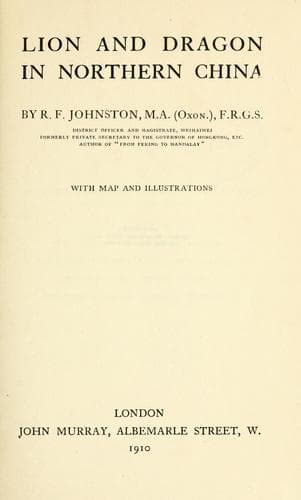
Lion and Dragon in Northern ChinaJohnston, Reginald Fleming, Sir
History
Lion and Dragon in Northern China
Johnston, Reginald Fleming, Sir
Weihai (China) -- History; Weihai (China) -- Social life and customs
As we saw in the last chapter, Chinese marriages, in spite of their
supposed pre-natal origin, are not always productive of lifelong
happiness; but as an offset to the melancholy picture there drawn of
many domestic infelicities, it is only fair to emphasise the unruffled
peace and contentment of very many Chinese households. In numerous
cases this happy condition of affairs is the result of a real if
somewhat undemonstrative love between husband and wife--a love that
is perhaps all the more likely to be firm and lasting because it
only sprang into existence after marriage. It is obviously difficult
to cite instances of this. It is the unhappy marriages, not the
happy ones, that in China--as everywhere else--engage the attention
of an administrator or a judge. But sometimes a suicide occurs in
circumstances which indicate that the moving impulse can only have been
deep grief for the death of a beloved wife or husband. I have had cause
to investigate officially no less than three such cases within two
months.
A man named Chang Chao-wan died after a short illness. A few hours
later, at midnight, his wife, who had previously shown every sign of
intense grief, hanged herself. It was ascertained that the couple had
lived a happy married life for nearly forty years. He was fifty-eight
years of age, she was fifty-seven. They had three sons, all grown-up.
In a case like this the action of the woman cannot be attributed to a
desire for notoriety or a hope of posthumous honours, for it is only
young widows who have any reason to expect such rewards.
The second instance is perhaps of greater interest. The story may be
stated in the words of the man who first reported it. "My second son,
Ts'ung Chia-lan, went to Kuantung (Manchuria) a few months after his
marriage. This was eight years ago. He went abroad because the family
was poor and he wanted to make some money. His wife was very miserable
when he went and begged him not to go, but he promised to come back to
her. He disappeared, and for years we heard nothing of him. His wife
made no complaint, but she was unhappy. A few months ago a returned
emigrant told us that he had seen my son in Manchuria. When I saw that
this news made his wife glad I sent my elder son, Chia-lin, to look for
him and bring him home. My elder son was away for more than two months
and never found him. Then he returned by himself and told us there was
no hope of our ever seeing Chia-lan again. His wife heard him say this.
We tried to console her. She said nothing at all, but two hours after
my elder son had come home she took a dose of arsenic and died. She was
a good woman, and no one ever had a complaint to make against her. She
had no child."
Public-domain text, read in full here on John Shaqi.
Reviews
Reviews
No reviews yet
Be the first to share your thoughts on this work.
Elsewhere in the archive
Join the Discussion
Join the discussion
Sign in to leave a comment or review.
Sign InorCreate an account