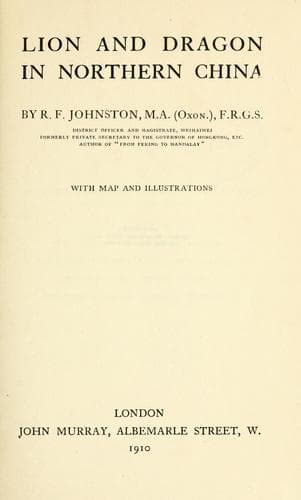
Lion and Dragon in Northern ChinaJohnston, Reginald Fleming, Sir
History
Lion and Dragon in Northern China
Johnston, Reginald Fleming, Sir
Weihai (China) -- History; Weihai (China) -- Social life and customs
The last case to be mentioned shows that it is not women only who can
throw away their lives on the death of their loved ones. A native of
the village of Hai-hsi-t'ou came to report the suicide of a nephew,
Tung Ch'i-tzŭ. "He was twenty years old," said my informant. "He
was deeply attached to his wife and she to him. She died about six
weeks ago. They had been married less than two years and they had no
children. He was very unhappy after her death, and would not let any
one console him. He was left alone, and yesterday when his father had
gone to market he hanged himself from a beam with his own girdle. There
was no other motive for the suicide. He died because he loved his wife
too much, and could not live without her."
Deaths and suicides have made a dismal chapter, and perhaps no better
way could be devised of lightening the gloom than by turning to a
source of brightness that does more to make homes happy--Chinese
homes and Western homes--than anything else in the world. To say that
the Chinese love their children would be unnecessary: they would be
a unique race if they did not. But it may not be accepted equally
readily that Chinese girls and boys are charming and lovable even when
compared with the modern children of western Europe and America, who
have all the resources of science and civilisation lavished on their
upbringing, and for whose benefit has been founded something like a
special branch of psychology. Perhaps there has been no section of
the Chinese people more hopelessly misunderstood by Western folk than
the children. It is not unnatural that such should be the case. It is
but rarely that feelings of real sympathy and mutual appreciation can
exist between Chinese children and adult Europeans. It would be futile
to deny the fact that by the Chinese child we are almost sure to be
regarded as fearfully and wonderfully ugly--and all good children
have an instinctive dislike of the ugly. Our clothing is ridiculous;
our eyes and noses are deformed; our hair (unless it is black) looks
diseased; our language--even if we profess to speak Chinese--is
strangely uncouth; and the particular blandishments we attempt are
not of the kind to which they are accustomed, or to which they know
how to respond. There is no use in saying "goo-goo" to an infant that
expects to be addressed with a conciliating "fo-fo"; nor should we be
surprised if we fail to win the approval of a shy Chinese youngster
by talking to him on the topics that would rouse the interest of the
twentieth-century English schoolboy. As likely as not he will remain
stolidly indifferent, and will stare at his well-meaning interlocutor
with a disconcerting lack--or apparent lack--of intelligence. No wonder
is it that the mortified foreigner often goes away complaining that
Chinese children are ugly, stupid, horrid and ungracious little urchins
and that he will never try to make friends with them again.
Public-domain text, read in full here on John Shaqi.
Reviews
Reviews
No reviews yet
Be the first to share your thoughts on this work.
Elsewhere in the archive
Join the Discussion
Join the discussion
Sign in to leave a comment or review.
Sign InorCreate an account