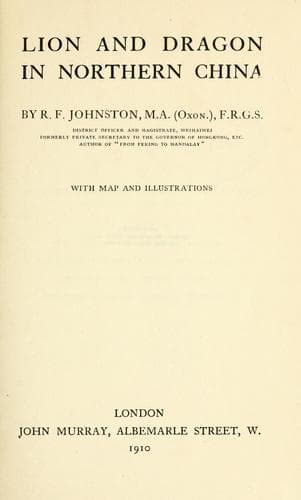
Lion and Dragon in Northern ChinaJohnston, Reginald Fleming, Sir
History
Lion and Dragon in Northern China
Johnston, Reginald Fleming, Sir
Weihai (China) -- History; Weihai (China) -- Social life and customs
Chinese law strongly supports the sanctity of the home and is
very severe on unfaithful wives, but it regards the killing of an
illegitimate child as a very light offence,--indeed case-made law
regards it as no offence at all provided the killing be done at the
time of the child's birth or before it. Fortunately cases of this kind
in Weihaiwei are very rare. But the poorest classes have one most
objectionable custom which seems to be strangely inconsistent with
the undoubted fondness of parents for their children. This is the
practice of throwing away or exposing the bodies of children who have
died in infancy or in very early childhood. This seems to indicate
an extraordinary degree of callousness in the natures of the people.
How a mother can fondle her child lovingly and watch over it with the
utmost care and unselfishness when it is sick, and yet can bear to see
its little body thrown into an open ditch or left on a hillside to
become the prey of wolves or the village dogs, is perhaps one of those
mysterious anomalies in which the Chinese character is said to abound.
Even New Guinea babies are treated after death with more respect than
is sometimes the case in China.[186] Needless to say the British
Government has not remained inactive in the matter, and the man who now
refrains from giving his infant child decent burial knows that he runs
a risk of punishment.
The only excuses that can be made for the people in this respect are
not based on their poverty (for poverty does not prevent them from
burying their adult relatives with all proper decorum) but on their
theory that an infant "does not count" in the scheme of family and
ancestral relationships. No mourning of any kind is worn for children
who die under the age of about eight, and only a minor degree of
mourning for older children who die unmarried and unmarriageable. Even
when a young child's body is given a place in the family burial-ground
care is always taken to choose a grave-site that is not likely to
be selected for the burial of any senior,[187] for it is considered
foolish and unnecessary to waste good _fêng-shui_ on a mere child, who
has left no descendants whose fortunes it can influence.
Young children are not indeed regarded as soulless,[188] for there are
touching ceremonies whereby a mother seeks to recall the soul of her
child when it seems likely to fly away for ever; but child-spirits are
not supposed to exercise any control over the welfare of the family.
They never "grow up" in the spirit-world, but merely remain infant
ghosts, powerful in nothing. The ancestral temples preserve no records
of dead children nor are their names inscribed on spirit tablets.
This is very different from the state of things existing among a race
that is ethnically far inferior to the Chinese, namely the Vaeddas of
Ceylon, who pay special attention to "the shades of departed children,
the 'infant spirits,'"[189] and often call upon them for aid in times
of unhappiness or calamity.
Public-domain text, read in full here on John Shaqi.
Reviews
Reviews
No reviews yet
Be the first to share your thoughts on this work.
Elsewhere in the archive
Join the Discussion
Join the discussion
Sign in to leave a comment or review.
Sign InorCreate an account