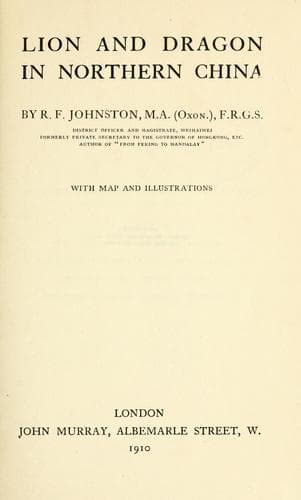
Lion and Dragon in Northern ChinaJohnston, Reginald Fleming, Sir
History
Lion and Dragon in Northern China
Johnston, Reginald Fleming, Sir
Weihai (China) -- History; Weihai (China) -- Social life and customs
[172] While this chapter was being written the newspapers reported a
case of a patriot's suicide which may be cited as typical. "An Imperial
Edict issued on September 5," says _The Times_ of September 21, 1909,
"bestowed posthumous honours upon the Metropolitan official Yung Lin,
who recently 'sacrificed his life in order to display his patriotism.'
The Edict is in reply to a memorial from the supervising censor of the
Metropolitan circuit and others asking for the Imperial commendation
of an act which has attracted great attention in Peking. Yung Lin,
a Manchu of small official rank but high literary gifts, bemoaning
the fate of his country, recently presented a petition to the Regent
'dealing with the circumstances of the times, and then gave up his
life.' Unable to present it in person, he sent his memorial to the
Press. It is a model of finished literary style. Imperial approval
will certainly be given to its official publication throughout the
Empire." In the course of his memorial, in which he alluded to and
bewailed the misfortunes of China and the crimes of those in high
places, Yung Lin expressed his belief that unless reforms speedily take
place, the "foreigners will seize the excuse of protection for chapels
and Legations to increase their garrisons, while secretly pursuing
their scheme for converting their sojourn in the land into ownership."
He also makes some remarks which, though they would meet the hearty
support of a Ruskin, will not be relished by foreign traders. Writing
of the waste of the national resources, he says that "vast sums of
money are frittered away in the purchase of useless foreign goods."
After sending his memorial to the Press, Yung Lin cut his throat.
The direct or indirect results of this affair will perhaps be more
far-reaching than may at present be thought likely.
[173] G. Chatterton Hill, _Heredity and Selection in Sociology_, p. 187.
[174] See Campbell Oman's _Cults, Customs and Superstitions of India_
(Fisher Unwin: 1908), p. 108.
[175] Cases in modern times where Chinese widows have actually been
compelled to commit suicide on their husbands' death are referred to in
Smith's _Chinese Characteristics_ (5th ed.), p. 215.
[176] See p. 203.
[177] See pp. 204 _seq._
[178] See p. 47.
[179] The technical term almost invariably used for this action is
_hsün_, which is the word used for the old practice of _burying alive
with the dead_. In modern times, as in all these stories, the word
signifies the death of a widow who commits suicide to prove her wifely
fidelity.
[180] Obviously because they wished to arrange a new betrothal for her.
[181] The Underworld of disembodied souls.
[182] In Peking and many other places the bridegroom does not _ying
ch'in_ or "go to meet the bride." He stays at home and awaits her
arrival.
Public-domain text, read in full here on John Shaqi.
Reviews
Reviews
No reviews yet
Be the first to share your thoughts on this work.
Elsewhere in the archive
Join the Discussion
Join the discussion
Sign in to leave a comment or review.
Sign InorCreate an account