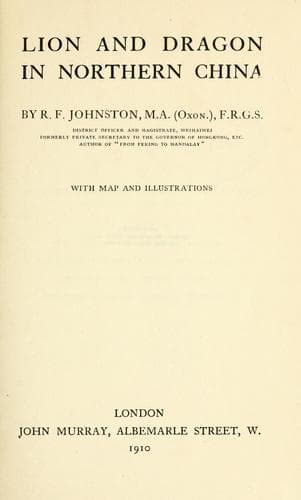
Lion and Dragon in Northern ChinaJohnston, Reginald Fleming, Sir
History
Lion and Dragon in Northern China
Johnston, Reginald Fleming, Sir
Weihai (China) -- History; Weihai (China) -- Social life and customs
[183] This is a temporary tablet in which the soul of the deceased
is supposed to reside till after the burial, when it is formally
summoned to take up its abode in the wooden tablet intended to remain
permanently in the possession of the family. In the present case the
temporary tablet would be ceremonially destroyed by fire after it had
served its purpose.
[184] See the _Chou Li_. In Peking and many other places the women
still accompany the funeral party to the graveside.
[185] In China the belief that inspires this practice is that the
greater the number of mourners who throw handfuls of earth on the
coffin, the greater will be the prosperity of the family in future
and the more numerous its descendants. The custom is not, of course,
confined to China. It is mentioned by Sir Thomas Browne as a practice
of the Christians, "who thought it too little, if they threw not the
earth thrice upon the interred body" (_Urn-Burial_, ch. iv.).
[186] See Grant Allen's _The Evolution of the Idea of God_, pp. 52 and
69.
[187] See p. 266.
[188] According to the Fijian Islanders the souls of the unmarried are
soon extinguished in the Underworld. See Tylor's _Primitive Culture_
(4th ed.), vol. ii. p. 23.
[189] Tylor, _op. cit._, vol. ii. p. 117.
CHAPTER XI
FAMILY GRAVEYARDS
Not the most unobservant visitor to China can fail to notice the
ubiquity of graveyards. In Western countries one is usually obliged
to ask the way to a cemetery; in China one finds the way by merely
walking in any direction one pleases. Nowhere so vividly as in China
does one realise that not only the path of glory but every other kind
of path leads but to a grave. The sight is sometimes a melancholy
one; as dreary as some of the city churchyards in England are the
vast cemeteries for the poor that cover the bare hillsides in the
neighbourhood of many great Chinese cities. The omega-shaped tombs
of south China are apt, moreover, to appal one by their vastness and
too often by the barren cheerlessness of their surroundings. But
there is nothing dismal in the family graveyards that dot the valleys
of the country districts in the north. Indeed, in a region like the
north-eastern extremity of Shantung, where there is of course no
tropical vegetation and where timber is scarce, the wooded graveyards
form one of the pleasantest features in every landscape. If while
walking across the fields of the Weihaiwei Territory one comes across
a thick plantation of trees--such as the fir and the Chinese oak,
which is never leafless--one is sure to find that it marks the last
resting-place of a family or a clan that inhabits or once inhabited
some village not far away. The plantation is surrounded by no wall
or fence of any kind; such would be a useless precaution, for no
one--except an occasional rascal who "fears neither God nor man"--will
knowingly injure a funereal tree or otherwise violate the sanctity of
the home of the dead. At the first glance the tombs may not be visible,
Public-domain text, read in full here on John Shaqi.
Reviews
Reviews
No reviews yet
Be the first to share your thoughts on this work.
Elsewhere in the archive
Join the Discussion
Join the discussion
Sign in to leave a comment or review.
Sign InorCreate an account