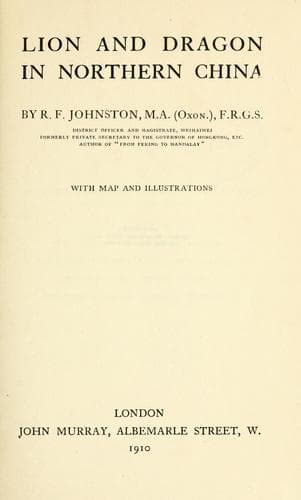
Lion and Dragon in Northern ChinaJohnston, Reginald Fleming, Sir
History
Lion and Dragon in Northern China
Johnston, Reginald Fleming, Sir
Weihai (China) -- History; Weihai (China) -- Social life and customs
It is the hope of every Chinese, then, that when he dies he will be
laid in his ancestral graveyard, and that he will be laid there in a
state of organic completeness. But there are occasions, of course,
when it has proved impossible to convey dead men's bones from one
end of China to another, or home from a foreign land: sometimes the
family cannot afford the expense, sometimes there are overwhelming
difficulties with regard to transport. Chinese ingenuity long ago set
itself to devise a means whereby even such bad cases as this might have
a happy ending, and it succeeded. The body itself, it was argued, is
of no real importance: for sentimental reasons it is satisfactory to
be able to bury the bodies of the dead in their ancestral graveyards,
but otherwise there is no urgency in the matter provided only the dead
man's souls--in spite of the absence of the body with which they were
associated--can be persuaded or induced to take up their respective
abodes in the ancestral graveyard and in the spirit-tablet. The problem
was solved by calling in the aid of religion, and the ceremony observed
is in outline something like this.
The members of the deceased's family, clad of course in funereal garb,
call in a priest who, in accordance with the data provided by them,
prepares a scroll containing the dead man's name and age and the date
and place of his death. They then make a very rough effigy of a man--a
few twisted straws are quite good enough--and on the effigy they pin
the scroll. The priest now performs the ceremony of "calling the soul
back"--that is to say, he recites certain charms which are supposed
to reach the wandering spirit, wherever it may be, and to draw it to
the place where the ceremony is to take place. The utterance of a few
more charms is supposed to be sufficient to attach the spirit to the
effigy-or rather to the scroll--which is then placed in a miniature
coffin and buried with the rites observed at ordinary funerals. The man
himself, to all intents and purposes, now lies buried in the ancestral
graveyard, and all that remains to be done is to evoke the spiritual
presence that will in future inhabit the _shên-chu_ or spirit-tablet.
When this has been done (just in the same way as when a real corpse
lies buried) the ceremony is at an end: the soul, or rather the
combination of souls, has been saved from homelessness, and will in
future assume its proper position as an ancestral ghost both in the
family graveyard and in the ancestral temple.
Public-domain text, read in full here on John Shaqi.
Reviews
Reviews
No reviews yet
Be the first to share your thoughts on this work.
Elsewhere in the archive
Join the Discussion
Join the discussion
Sign in to leave a comment or review.
Sign InorCreate an account