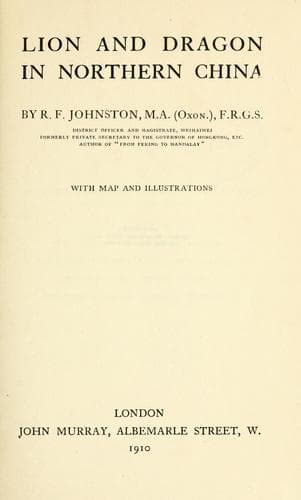
Lion and Dragon in Northern ChinaJohnston, Reginald Fleming, Sir
History
Lion and Dragon in Northern China
Johnston, Reginald Fleming, Sir
Weihai (China) -- History; Weihai (China) -- Social life and customs
This remarkable custom is obviously such a convenient means of avoiding
the trouble and expense of conveying dead bodies from distant places,
that its comparative rarity may well be a matter of some surprise.
Certainly, if the practice were to come into common use it would
indirectly give a great impulse to emigration: for which reason it
may perhaps be hoped by some Western peoples that it will for ever
remain unfashionable. The custom is, however, an exceedingly old one,
and was practised even at the Imperial Court nearly nineteen centuries
ago.[224] There seems to have always been a strong prejudice against
it, partly because it was a foolish superstition and partly because it
would tempt the people to cease troubling themselves about the burial
of their parents or bringing home their bodies from a distance, and
would thus tend to the degradation or weakening of the ideals of filial
piety. Hence we find that the practice of burying souls without the
bodies was in 318 A.D. condemned by Imperial Decree as heretical;[225]
yet this condemnation by no means brought about its discontinuance, and
the present legal position is that the "violation of a grave in which
an evoked soul is interred shall be punished just as severely as the
violation of a grave occupied by a corpse,"[226] that is to say the
offender may be sentenced to death.
In his interesting section on this strange custom Dr. De Groot remarks
that as it has been "of common prevalence for at least eighteen
centuries" its occurrence even nowadays can hardly be doubted. It
certainly exists at Weihaiwei, though it is not in very common use. One
reason for practising it in this little corner of China is based on
the very strong belief that husband and wife should always be buried
in the same grave. If the husband dies while he is abroad and the body
is lost or cannot be brought home, nothing is necessarily done until
his widow (who has remained at home) dies also. When she is buried, her
husband's soul is ceremonially summoned to take up its residence in a
paper scroll bearing the _pa ko tzŭ_ ("eight characters" naming the
year, month, day and hour of birth), and this, with or without a straw
effigy, is formally placed in the grave by the widow's side.
Public-domain text, read in full here on John Shaqi.
Reviews
Reviews
No reviews yet
Be the first to share your thoughts on this work.
Elsewhere in the archive
Join the Discussion
Join the discussion
Sign in to leave a comment or review.
Sign InorCreate an account