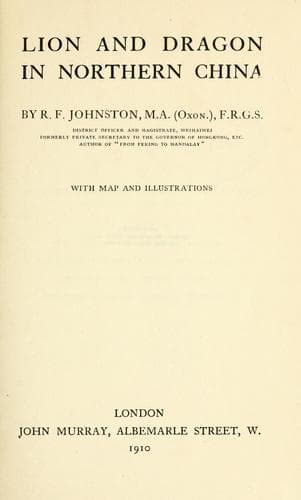
Lion and Dragon in Northern ChinaJohnston, Reginald Fleming, Sir
History
Lion and Dragon in Northern China
Johnston, Reginald Fleming, Sir
Weihai (China) -- History; Weihai (China) -- Social life and customs
A practical reason for this proceeding at once suggests itself if
it has happened that the couple were childless and were the owners
of property. It then becomes necessary for the elders of the clan to
select an heir; and as an adopted heir--who must be a "spare" son of
a relative--is obliged to separate himself from his own branch of
the clan and to regard the dead man and his wife for the future as
his proper parents, matters must be so arranged that he can become
possessor of his adoptive father's spirit-tablet. As the dead man's
spirit is not supposed to take up its abode in the tablet until he has
been interred with the proper rites in the family graveyard, it is
necessary, if his body is missing, to evoke and inter its spiritual
representative. If this were not done, the adopted heir would be unable
to carry on the ancestral rites except in an irregular way, and this
might lead to serious legal difficulties later on in the event of
another member of the clan disputing the genuineness of the adoption
and heirship.
A point worth noting in connection with ancestral worship and adoption
is that (in this part of China at least) the mere fact of childlessness
does not necessarily lead a man to adopt a son: it is childlessness
combined with the ownership of property that induces him to do so.
We will suppose that a man has obtained his share of the family
inheritance; that it is too small to support him; that he has sold
it to relatives and with the cash proceeds has gone abroad to make a
living; that he returns as an old man, childless and penniless: this
man will in all probability show no desire to adopt a son, nor indeed
is it likely that he could succeed in doing so if he wished it. The
ancestral worship will not suffer by his childless death provided he
has brothers and nephews to perpetuate the family _sacra_. Even if it
happens that he is actually the last of his house and that his death
will bring the ancestral cult of his line to an abrupt conclusion, it
is not likely that, for the sole purpose of carrying on the sacra, the
last of the line will bestir himself to go through the formalities
necessary for the adoption of a son. The fact is that the possession
of property--especially landed property--is regarded in practice as
an inseparable condition of the continuation of the ancestral rites.
This theory is often expressed in the formula _mei-yü ch'an-yeh
mei-yü shên-chu_--"no ancestral property, no ancestral tablets." If
the spirits of the deceased ancestors have been so regardless of the
interests of their descendants that they have allowed the family
property to pass into the hands of strangers, it is thought that
they have only themselves to blame if for them the smoke of incense
no longer curls heavenward from the domestic altars. Indeed, there
is a vague idea that as the family line dwindles and finally becomes
extinct on the material plane, so on the spiritual plane the ancestral
Public-domain text, read in full here on John Shaqi.
Reviews
Reviews
No reviews yet
Be the first to share your thoughts on this work.
Elsewhere in the archive
Join the Discussion
Join the discussion
Sign in to leave a comment or review.
Sign InorCreate an account