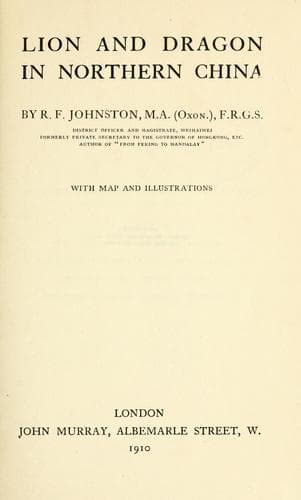
Lion and Dragon in Northern ChinaJohnston, Reginald Fleming, Sir
History
Lion and Dragon in Northern China
Johnston, Reginald Fleming, Sir
Weihai (China) -- History; Weihai (China) -- Social life and customs
Ancestral spirits are regarded as beneficent beings who never
causelessly use their mysterious powers to injure the living; but if
their descendants lead evil lives, or neglect the family sacrifices,
or treat the sacred rules of filial piety with contempt, then the
spirits will in all probability exercise the parental prerogatives
of punishment. The power of a father in China to castigate his son
is theoretically as absolute in the case of a grown-up son as in the
case of one who is still a child: similarly it is supposed that the
father does not, by the mere accident of death, divest himself of his
patriarchal rights of administering justice and inflicting punishment
on his sons and grandsons. Provided a man carefully observes the
traditional ceremonies and leads a good life according to the accepted
ethics of his race, he knows that he has nothing to fear from the souls
of his ancestors.
But there are in China various classes of ghosts who are supposed to be
highly malevolent and to constitute no small danger to the community.
There are, for example, the ghosts whose tempers have been soured by
calamity and misfortune; those whose bodies have not been buried;
those who were drowned at sea; those who ended their mortal lives by
unjustifiable suicide and haunt the place where they died until they
can, by ghostly suggestions, prevail on one of their earthly neighbours
to follow their example;[227] those who died before accomplishing a vow
or completing an act of vengeance: these and many others are ghosts or
evil spirits which the wise man who walks warily through life will do
his best to avoid.
The curious and cruel superstition which sometimes prevents a Chinese
from helping a drowning comrade even when he could save the man without
danger to himself has its origin in a fear that he will incur the
deadly hostility of a spirit that demands the toll of a human life.
It is even thought in some places that by saving your friend you may
be condemning yourself to be his future substitute. This superstition
has existed in many parts of the world--from Ireland to the Solomon
Islands.[228] It need hardly be said that educated opinion in China is
altogether opposed to the heartless abandonment of drowning men: the
superstition is an active force only in a few localities, and only to a
minute extent, if at all, may it be said to exist in Weihaiwei.
Public-domain text, read in full here on John Shaqi.
Reviews
Reviews
No reviews yet
Be the first to share your thoughts on this work.
Elsewhere in the archive
Join the Discussion
Join the discussion
Sign in to leave a comment or review.
Sign InorCreate an account