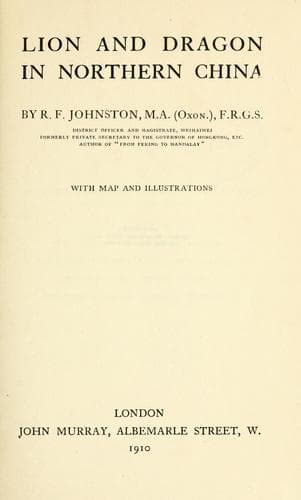
Lion and Dragon in Northern ChinaJohnston, Reginald Fleming, Sir
History
Lion and Dragon in Northern China
Johnston, Reginald Fleming, Sir
Weihai (China) -- History; Weihai (China) -- Social life and customs
A vestige of it is possibly to be traced in the fact that "wrecking"
is not regarded as a very serious breach of sound ethics. When British
rule was first established at Weihaiwei pitiful scenes were to be
witnessed during the tempests of winter, when junk after junk was
hurled against the rock-bound coast. No great effort was made to save
human life; indeed, there is reason to believe that men were allowed
to freeze to death on the shore or to be battered to death by the
merciless waves while those who could and should have come to their
rescue actually stepped over their bodies while on the eager search
for remnants of wrecked cargo. All this has been so greatly changed
that storm-driven junks in the Gulf of Chihli have been known to make
deliberately for the coasts of Weihaiwei, their crews believing that
if disaster must come there would be a greater chance of safety for
themselves and less risk of having their cargoes looted on the shores
of British territory than anywhere else along the coast of Shantung.
Two or three of the village headmen have shown great loyalty in
accepting and carrying out British policy in this matter, and have been
personally instrumental in saving numbers of lives and in helping the
crews of wrecked junks to salve their cargoes and to repair the damage
done to their vessels. The headman who has shown himself most energetic
in this good work deserves special mention. He is Ch'ê Shuo-hsüeh, the
district headman of Hai-hsi-t'ou. To him the Government of Weihaiwei
has presented a _pien_ or carved complimentary tablet.[229] The
inscription reads _Chêng jên yü wei_--"Human lives rescued from peril."
Tablets of this kind when presented by the official authorities are
highly valued by the Chinese, and are preserved as heirlooms.
[Illustration: A WRECKED JUNK.]
[Illustration: A JUNK ASHORE.]
But the spirits that drag men into the waters of a river or down to
Lung Wang's palace in the depths of ocean at least make a practice of
confining their activity to their chosen element. Far more dangerous
are the gloomy homeless souls that stalk the country fields and prowl
round villages, always on the look-out for victims and always ready
to deceive the ignorant. There are terrible vampires and devil-foxes
that throw mists over men's eyes and minds and make them believe
they see before them damsels of bewitching beauty. It is difficult
indeed to save any one who has once passed under the dominion of a
fox-wife: he is a doomed man. A prevalent belief on the subject of
ghosts and goblins and evil spirits is based on a kind of theory of
predestination. The man who is fated not to be bothered by such beings
will escape them; he who is fated to be their prey cannot by any
possibility avoid them. The Chinese popular saying puts it more neatly:
"He who is born lucky can laugh at demons; the unlucky wight becomes
the demon's plaything."
Public-domain text, read in full here on John Shaqi.
Reviews
Reviews
No reviews yet
Be the first to share your thoughts on this work.
Elsewhere in the archive
Join the Discussion
Join the discussion
Sign in to leave a comment or review.
Sign InorCreate an account