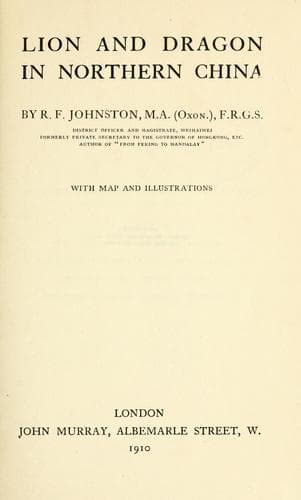
Lion and Dragon in Northern ChinaJohnston, Reginald Fleming, Sir
History
Lion and Dragon in Northern China
Johnston, Reginald Fleming, Sir
Weihai (China) -- History; Weihai (China) -- Social life and customs
As it is no one's special business to propitiate malevolent spirits,
the obligation is one that is understood to rest with the Government.
Among the numerous religious duties of the district-magistrates is
that of quieting the evil propensities of all bad ghosts or spirits.
In the district-city of Jung-ch'êng, for instance, among the altars at
which official rites must periodically take place is one called the _Li
T'an_, a phrase which may be translated as an Altar to Evil Spirits.
Three times a year--namely at the three great festivals of the Dead or
Souls' Days[231]--the district-magistrate and other local officials
attired in ceremonial robes proceed to the _Li T'an_ and there offer up
sacrifices of propitiation to all harmful spirits. The process consists
in issuing to all homeless and tablet-less ghosts a solemn invitation
to a banquet. The viands provided are three sheep, three pigs, three
measures of grain and an indefinite quantity of paper-money. All this
is supposed to satiate or pacify the spirits so that they cease to do
harm to mankind at least until the arrival of the next sacrificial
festival.
In China, as in Europe, there are various strange beliefs connected
with the mysterious powers supposed to be inherent in corpses. As soon
as a man or woman is dead the family take care that no dogs or cats
(especially cats) shall be allowed into the mortuary chamber, as it is
believed that so long as the coffin has not been closed the approach
of one of these animals will cause the corpse to jump. This is a
well-known superstition in Weihaiwei; and from De Groot's work, which
deals more particularly with a portion of the southern province of
Fuhkien, it may be gathered that it exists in other parts of the Empire
also.[232] De Groot (who mentions cats only, not dogs) accounts for
the idea by referring it to the domain of tiger-lore. Each member of
the feline race, he says, is supposed to have on its tail a miraculous
hair, which has the power of bringing the soul back to any human body
from which it had already departed. But why should this be objected
to, seeing that, as De Groot has himself pointed out, the main object
of the tearless howling at Chinese funerals, which has so often rather
unjustly excited the ridicule of Europeans, is to call back the soul of
the departed?
Public-domain text, read in full here on John Shaqi.
Reviews
Reviews
No reviews yet
Be the first to share your thoughts on this work.
Elsewhere in the archive
Join the Discussion
Join the discussion
Sign in to leave a comment or review.
Sign InorCreate an account