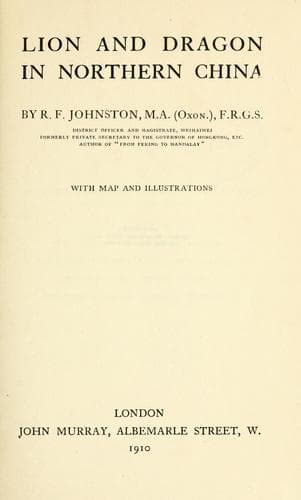
Lion and Dragon in Northern ChinaJohnston, Reginald Fleming, Sir
History
Lion and Dragon in Northern China
Johnston, Reginald Fleming, Sir
Weihai (China) -- History; Weihai (China) -- Social life and customs
The Weihaiwei Annals tell a story of a man who must have been born
lucky. His name was Kuo and he belonged to Ch'in Ts'un, a village
that lies a few miles from Port Edward. One evening he was returning
from the sea-side with a load of fish. On the way he met a ghost, who
pressed Kuo to allow him to carry his load. Kuo, not in the least
dismayed, congratulated himself on a welcome relief and promptly
placed his burden on the ghost's shoulders. Man and ghost trudged along
contentedly side by side for some distance, but on arriving at Ch'in
Ts'un the dogs began to bark, and the ghost, thinking this was no place
for him, suggested that he must say good-bye. Kuo refused to hear of
such a thing and insisted that the ghost should accompany him home
and share his evening meal. On reaching home Kuo asked his unearthly
visitor to sit down, and ordered his wife and child to set about
getting supper ready. When the water was boiling he furtively threw
into the cooking-pot some fragments of decayed wood and an old nail.
The whole party, including the ghost, enjoyed a hearty meal, and when
it was over the ghost took his leave without having done the least harm
to any one.
"If men are not afraid of ghosts," adds the Weihaiwei chronicler,
"ghosts will not be able to do them any injury. When this story
is attentively considered the truth of that statement will become
increasingly evident." But he tells the story with perhaps the
suggestion of a twinkle in his eye: for in the course of the narrative
he interjects the remark, to which he adds no comment, that Kuo's
besetting weakness was strong drink. It is remarkable that he offers
no explanation of Kuo's action in throwing pieces of decayed wood and
a nail into the cooking-pot, though this was just where Kuo showed
his cunning. To put rotten wood and old iron into one's porridge will
appear a meaningless rite to the uninstructed. It is a practical
illustration of a popular Chinese belief that marvellous efficacy
in destroying the evil influences of ghosts and demons and other
ill-omened beings is inherent in rotten wood and nails taken from
_old coffin-boards_ which have been actually used for the burial of
a corpse. Kuo's rotten wood was--though the chronicler leaves that
important point to his reader's intelligence--wood that had once
formed part of a coffin.[230] This little story shows conclusively
that though in Europe if one sups with the devil one must use a long
spoon, in Weihaiwei one wants nothing more than a piece of coffin-wood
and an old nail.
Public-domain text, read in full here on John Shaqi.
Reviews
Reviews
No reviews yet
Be the first to share your thoughts on this work.
Elsewhere in the archive
Join the Discussion
Join the discussion
Sign in to leave a comment or review.
Sign InorCreate an account