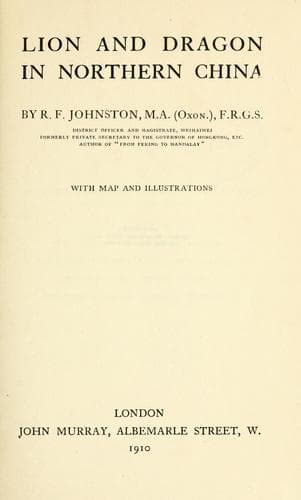
Lion and Dragon in Northern ChinaJohnston, Reginald Fleming, Sir
History
Lion and Dragon in Northern China
Johnston, Reginald Fleming, Sir
Weihai (China) -- History; Weihai (China) -- Social life and customs
I have described this superstition as it exists at Weihaiwei, but it
is by no means confined to that locality. The word _han-pa_ means
"demon of drought," and the earliest mention of it in extant Chinese
literature is in the beautiful hymn of King Hsüan, preserved in the
Book of Poetry (_Shih Ching_) edited by Confucius.[244] It is there
mentioned as being the cause of a great drought that appears to have
occurred about the year 821 B.C. The drought-demon is also referred
to in the _Shan Hai Ching_, a curious quasi-geographical work of
disputed date. A certain Taoist Book of Marvels tells us that "in the
southern regions there is a man-like creature two or three feet high,
with a naked body and an eye on the top of its head. It moves with the
swiftness of wind, and wherever it is seen a calamitous drought is sure
to occur. It is called _pa_."[245] From none of these authorities do we
gather that there was any connection between the drought-demon and a
human corpse over which tears had been shed. Wang Ch'ung (first century
A.D.) writes of "flying corpses" (_fei shih_),[246] but this does not
bring us much further. How the superstition as it at present exists
grew up is far from clear, and it seems likely that it represents a
coalescence of several beliefs that were once quite separate. De Groot
discusses the subject with his usual thoroughness,[247] though he does
not appear to have come across the superstition in the form in which it
is known at Weihaiwei.
It might well be supposed that in the _han-pa_, if in nothing else,
we have come across a piece of Chinese folk-lore that has no parallel
in Europe; but perhaps our supposition would be unwarrantably hasty. I
find that in the Highlands of Scotland "it was thought wrong to weep,
lest the tears should hurt the dead."[248] Then again there is, or
was, an English superstition against the use of certain feathers in
feather-beds and pillows. The feathers of the domestic fowl, goose,
pigeon, partridge, and sometimes those of wild birds generally, were
tabooed.[249] No reason has been given so far as I know for this
singular and apparently senseless idea, any more than for the Highland
notion that tears were hurtful to the dead. It may be far-fetched to
suppose on the strength of these old wives' tales that the shedding
of tears over corpses was once believed by our own remote ancestors
to turn dead men into feathered demons like the Chinese _han-pa_; but
perhaps it might appear less unlikely that there is some extremely
ancient and now forgotten connection between the British and the
Chinese superstitions if we were able to find some traces of similar
beliefs in the intervening countries of Europe or Asia.
Public-domain text, read in full here on John Shaqi.
Reviews
Reviews
No reviews yet
Be the first to share your thoughts on this work.
Elsewhere in the archive
Join the Discussion
Join the discussion
Sign in to leave a comment or review.
Sign InorCreate an account