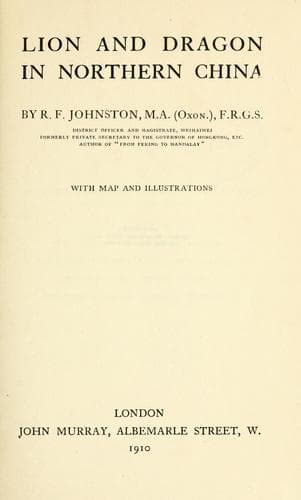
Lion and Dragon in Northern ChinaJohnston, Reginald Fleming, Sir
History
Lion and Dragon in Northern China
Johnston, Reginald Fleming, Sir
Weihai (China) -- History; Weihai (China) -- Social life and customs
For long I despaired of finding anything that might be regarded as a
missing link; but Bohemia is the country that seems to have supplied it
at last. The following letter will show that in Europe, as well as in
Far Cathay, there still exists in our own generation the remnant of a
belief that drought may in certain circumstances be caused by a human
corpse, and that such a corpse is in some mysterious way associated
with feathers.
"In the Bohemian village of Metschin," says a writer in
_Folk-lore_,[250] "the body of the schoolmaster, who was buried early
in May amid many marks of respect from the inhabitants, is to be
exhumed. There, as elsewhere, a great drought prevails, and the story
has got about that a cushion with feathers was put under his head.
Nine-tenths of the population believe that this is the cause of the
drought, hence the proposal to exhume him and remove the cushion,
which is in reality filled with hay. Is this case parallel to the
prejudice against the feathers of certain birds in beds and pillows,
or is there some special connection between feathers and rain? More
particularly in Australia feathers and hair are associated with
rainmaking."
It will be noticed that in China the drought-causing demon grows the
feathers on its own body, whereas in Bohemia it merely lies on a
feathered pillow. That the two beliefs had a common origin, and that
the two British superstitions already cited may be connected with them,
will not, perhaps, be regarded as altogether beyond the bounds of
possibility.
FOOTNOTES:
[213] See pp. 262 _seq._
[214] _The Religious System of China_, vol. i. p. 212. For full details
as to the procedure at Chinese funerals and the religious ceremonies
connected therewith, the reader is referred to Dr. De Groot's
monumental work, which deals minutely with this and kindred subjects.
[215] See p. 263. Needless to say, the ancestral temples of great or
wealthy families are on a very much grander scale.
[216] See p. 256.
[217] Instead of red ink it is in some parts of China customary to use
blood extracted from a cock's comb. For an explanation of this, and for
a full description of the ceremony of dotting the tablet, see De Groot,
_op. cit._ vol. i. pp. 214-19.
[218] See illustration.
[219] The terms used are honorific.
[220] That is, the eldest son of his father.
[221] See illustration facing next page, and that facing p. 278.
[222] _Op. cit._ vol. i. p. 114.
[223] We may smile at Chinese simplicity in such matters, but exactly
the same ideas have existed in the West. "A woman in our parish,"
writes a resident in Wiltshire, "had her leg amputated and got a little
coffin made for it. She caused it to be buried in the churchyard"--with
the view of joining it there at some future day. Many similar cases
have been observed in Ireland, and doubtless in many other parts of
western Europe. (See _Folk-lore_, March 1907, pp. 82-3, and June 1907,
p. 216.)
Public-domain text, read in full here on John Shaqi.
Reviews
Reviews
No reviews yet
Be the first to share your thoughts on this work.
Elsewhere in the archive
Join the Discussion
Join the discussion
Sign in to leave a comment or review.
Sign InorCreate an account