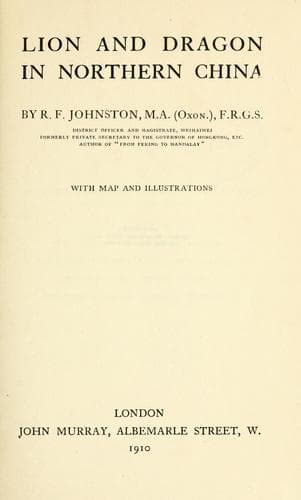
Lion and Dragon in Northern ChinaJohnston, Reginald Fleming, Sir
History
Lion and Dragon in Northern China
Johnston, Reginald Fleming, Sir
Weihai (China) -- History; Weihai (China) -- Social life and customs
95 and 286-7.) In Weihaiwei and many other places a single nail
_which serves no practical purpose_ is driven in (only far enough to
make it immobile) on one side of the coffin-lid, and this nail is
decorated with parti-coloured threads. The people of Weihaiwei seem to
have no explanation of this custom, but it is evidently a kind of charm
to bring wealth, happiness and an ample progeny to the family. The
charm is based on a play on the word _ting_, "nail," which also means
_a man_, or _male offspring_. As the nail (_ting_) is driven into the
parent's coffin, so, it is thought, will there always be males (_ting_)
to carry on the family; and as these five-coloured threads are wound
round the nail, so will wealth, prosperity, honours, long life and many
children be the portion of the sons of the family for all time to come.
[231] See p. 192.
[232] De Groot, _op. cit._ vol. i. pp. 43-4; vol. v. p. 750. See also
Dennys's _Folk-lore of China_, p. 20.
[233] _County Folk-lore_, vol. iii. (Orkney and Shetland), p. 216.
[234] Pennant's _Tour in Scotland_. See also Brand's _Antiquities_,
vol. ii. p. 233.
[235] G. L. Gomme's _Folk-lore Relics of Early Village Life_, p. 116.
I cannot agree with Mr. Gomme's interpretation of the superstition.
He regards it as connected with the "primitive hearth sacrifice." The
Chinese parallels seem to have been unknown to him.
[236] For China, see Dennys's _Folk-lore of China_, pp. 48, 90-91.
[237] See Frazer's _Golden Bough_ (2nd ed.), vol. iii. pp. 324 _seq._
[238] _County Folk-lore_, vol. iii. (Orkney and Shetland), p. 216.
[239] _Folk-lore Journal_, vol, ii. p. 281.
[240] Frazer's _Golden Bough_ (2nd ed.), vol. iii. pp. 294 _seq._
[241] Every day in the Chinese calendar is either lucky, unlucky, or
indifferent; and very many people will undertake no duty or work of
importance until they have consulted the fortune-telling almanac (a
new one is issued for each year), or have at least consulted temple
oracles. The Jewish Sabbath is now believed to have originated in a
similar superstition.
[242] Cf. the Irish and Scottish banshee.
[243] All evil demons are supposed to be afraid of brooms. See p. 190
(note).
[244] See Legge's _Chinese Classics_, vol. iv. pt. ii. p. 532. The
passage referred to is translated by Legge thus: "The demon of drought
[_han-pa_] exercises his oppression, as if scattering flames and fire."
[245] This passage is quoted in the K'ang Hsi dictionary, s.v. _Pa_.
[246] _Lun Hêng_, transl. by Forke, pt. i. p. 243.
[247] _Op. cit._ vol. v. pp. 516-20, 761. For remarks on human spectres
in the shape of birds, see vol. v. pp. 634 _seq._ For a reference to
the spectres known in Europe as Vampires, see vol. v. p. 747 _seq._ For
evidence as to the supposed existence of vampires and grave-demons in
the Malay States, see Skeat's _Malay Magic_, pp. 103 and 327.
[248] _Folk-lore Journal_, vol. ii. (1884), p. 281.
[249] _Folk-lore_, September 1900, p. 243.
Public-domain text, read in full here on John Shaqi.
Reviews
Reviews
No reviews yet
Be the first to share your thoughts on this work.
Elsewhere in the archive
Join the Discussion
Join the discussion
Sign in to leave a comment or review.
Sign InorCreate an account