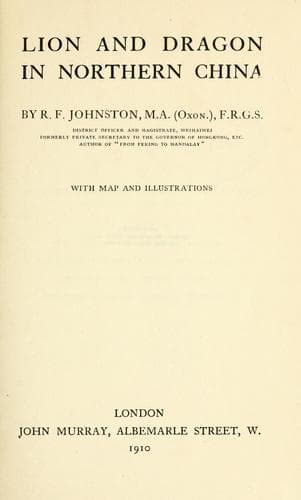
Lion and Dragon in Northern ChinaJohnston, Reginald Fleming, Sir
History
Lion and Dragon in Northern China
Johnston, Reginald Fleming, Sir
Weihai (China) -- History; Weihai (China) -- Social life and customs
[224] De Groot, _op. cit._ vol. iii. p. 848.
[225] De Groot, _loc. cit._ p. 849.
[226] De Groot, _loc. cit._ p. 854. The punishment under the Penal Code
for opening a grave and exposing the corpse is strangulation (subject
to confirmation).
[227] See p. 222.
[228] See Grant Allen's _Evolution of the Idea of God_ (pp. 265-7);
Tylor's _Primitive Culture_ (4th ed.), vol. i. pp. 108-11; W. G.
Black's _Folk-Medicine_, p. 29; and Dennys's _Folk-lore of China_,
p. 22. The superstition sometimes takes the form of a belief that
the rescued man will some day do some terrible injury to his
rescuer--perhaps at the instigation of the evil spirit who was balked
of his prey. It is quite erroneous to suppose that this superstitious
objection to saving the drowning is prevalent throughout all China. De
Groot (_op. cit._ vol. v. p. 526) states that he never found a trace
of it in the province of Fuhkien; "while, moreover, all the Chinese we
interrogated on this head protested against their humanity being thus
called in question."
[229] For the headman in question and his _pien_, see illustration.
[230] For an account of the popular belief with regard to old
coffin-wood and nails, see De Groot, _op. cit._ vol. i, pp. 328-9. See
also Doolittle's _Social Life of the Chinese_, p. 561; and Dennys's
_Folk-lore of China_ (p. 48), where it is said that "a nail that has
been used in fastening up a coffin is a sovereign charm. This is
sometimes beaten out into a rod or wire and, encased in silver, worn
as a ring round the ankles or wrists." It is very curious that even in
this matter of coffin-nails we can trace a close connection between
Chinese and Western European folk-lore. In the Shetland Islands (which
seem to possess many remarkable parallels with Chinese folk-lore) it is
said that toothache can be cured by picking the tooth "with the nail
of an old coffin." (_Folk-lore Journal_, vol. iii. p. 380.) In parts
of Yorkshire it was once the custom to take some coffin-lead or other
coffin-metal from a churchyard and have it made into a ring; it then
became a cure for cramp. (_County Folk-lore_, vol. ii. [North Riding of
Yorkshire] p. 171.) Similar beliefs existed elsewhere in England--in
Devonshire, for example. (See W. G. Black's _Folk-Medicine_, p. 175.)
It may be noted here that a thoroughly "orthodox" coffin in China is
supposed to have no nails at all, or as few as possible. The various
planks are fitted into grooves and notches with the deliberate
intention of avoiding the necessity of nails. This doctrine is well
understood at Weihaiwei and followed there as far as practicable. The
explanation of the nailless coffin given by De Groot is that it dates
from a period in extreme antiquity _when iron was unknown_. The form
of coffin that was adopted in a primitive age from necessity is used
in modern times from a spirit of conservatism, or from reverence for a
custom that time has sanctified. (_See_ De Groot, _op. cit._ vol. i.
pp.
Public-domain text, read in full here on John Shaqi.
Reviews
Reviews
No reviews yet
Be the first to share your thoughts on this work.
Elsewhere in the archive
Join the Discussion
Join the discussion
Sign in to leave a comment or review.
Sign InorCreate an account