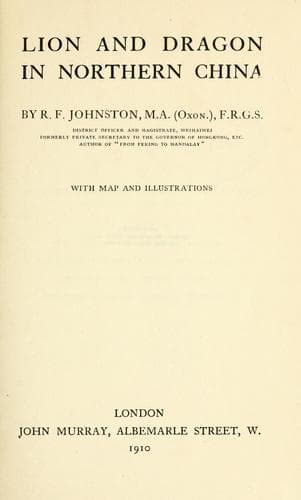
Lion and Dragon in Northern ChinaJohnston, Reginald Fleming, Sir
History
Lion and Dragon in Northern China
Johnston, Reginald Fleming, Sir
Weihai (China) -- History; Weihai (China) -- Social life and customs
I once heard a kind-hearted Englishman say that he could forgive China
all her faults except the torturing of prisoners in the law-courts
and in the gaols. Torture in China--which is very slowly becoming
obsolete--has very naturally made Europeans shudder with horror: but
where does Confucius give countenance to torture? And after all, the
extent of China's crime is only this, that she has not abolished the
practice of torture quite so early as the nations of Western Europe
and America. Perhaps the missionaries and others who have pointed out
to the Chinese the enormity of their crime in permitting torture have
sometimes omitted to state that only in comparatively recent times have
we ourselves become so merciful as to forbid the practice. Without
dwelling on the abominable punishments devised for heretical offenders
in every country in Europe, it is as well to remember that torture was
continually inflicted in England during the Tudor reigns,[263] and
also under the Stuarts. In Scotland it was long a recognised part of
criminal procedure, and was not finally abolished in that country till
the eighteenth century.[264] The Most High and Mighty Prince whose name
adorns the front page of our English Bibles, in one memorable case
directed the application, if necessary, of "the most severe" tortures,
and expressed the devout wish that the Almighty would "speed the good
work."
When confronted with so lofty an ethical system as that taught by
Confucius, European writers who wish to prove the justice of their
contention that "it must at every point prove inferior to Christianity"
are naturally driven to make the utmost of any passage in the Chinese
classics that appears to reveal something of the Chinese sage's moral
imperfections. Just as an anti-foreign Chinese commentator on the
Christian religion might utilise certain texts in the Old Testament to
show that the Christian God was neither just nor merciful, and certain
texts in the New Testament to show that Jesus of Nazareth shared the
superstitions of his age and was sometimes lacking in self-control, so
European expounders of Confucianism have seized upon a few passages in
the Confucian canon to prove to their own satisfaction that the great
Sage of China did not always speak the truth. The passages are three
in number. In one we are told that a certain brave man was commended
by the Master for his absence of boastfulness, because though he nobly
brought up the rear during a retreat, he said, "It is not courage that
makes me last, it is my horse that won't gallop fast enough."[265] As
courage really was the cause of his conduct, Prof. Legge and those
who think with him take the view that the man's own explanation of
what he had done was untruthful and that Confucius by awarding him
praise condoned a lie. Considering that Confucius's only remark on the
subject was that the man was no braggart, probably few of us except
sanctimonious pedants would say that either the sage or his hero was
Public-domain text, read in full here on John Shaqi.
Reviews
Reviews
No reviews yet
Be the first to share your thoughts on this work.
Elsewhere in the archive
Join the Discussion
Join the discussion
Sign in to leave a comment or review.
Sign InorCreate an account