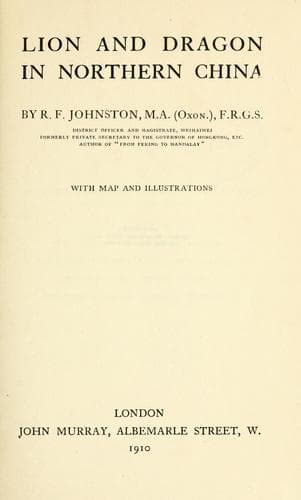
Lion and Dragon in Northern ChinaJohnston, Reginald Fleming, Sir
History
Lion and Dragon in Northern China
Johnston, Reginald Fleming, Sir
Weihai (China) -- History; Weihai (China) -- Social life and customs
guilty of an act or a word that was in any way discreditable.
In another famous passage it is narrated that "A man who wanted to see
Confucius called on him. Confucius, not wishing to see him, sent to
say he was sick. When the servant with the message went to the door,
Confucius took up his musical instrument and sang aloud purposely to
let the visitor hear it and know that he was not really sick."[266] It
is interesting to note that in citing this little story as evidence of
Confucius's lack of veracity, Prof. Legge omits to quote the second
part of the passage,[267] though it ought to be obvious to the most
casual reader that it was only for the sake of the remark about the
music that the story was preserved in the Confucian canon at all. So
far from proving that Confucius could tell a lie, it goes to show
that even in small matters of everyday social intercourse Confucius's
nature was superior to all the little "white lies" and deceptions that
are and no doubt always have been continually practised in "Society."
Probably in his day, as in our own, it was considered more polite to
an unwelcome visitor to plead indisposition or absence from home as an
excuse for not admitting him than to send him the blunt message, "You
are not wanted: go away!" Confucius, however, wishing to make it quite
clear to his visitor that the plea of sickness was merely a social
subterfuge and was not intended to deceive (as a lie must surely be),
took up his musical instrument and played it in his visitor's hearing.
So far from this passage proving that Confucius had an inadequate
regard for the truth, it will perhaps strike a good many people as
indicating that untruth and insincerity were abhorrent to Confucius's
nature: and this was undoubtedly the impression that the disciple who
remembered and recorded the incident wished to convey.
Public-domain text, read in full here on John Shaqi.
Reviews
Reviews
No reviews yet
Be the first to share your thoughts on this work.
Elsewhere in the archive
Join the Discussion
Join the discussion
Sign in to leave a comment or review.
Sign InorCreate an account