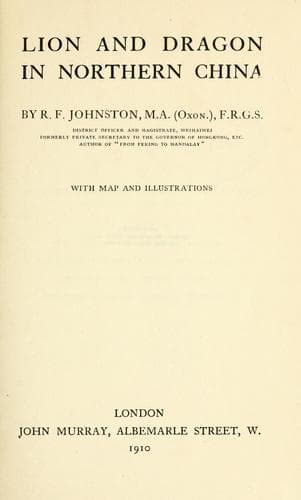
Lion and Dragon in Northern ChinaJohnston, Reginald Fleming, Sir
History
Lion and Dragon in Northern China
Johnston, Reginald Fleming, Sir
Weihai (China) -- History; Weihai (China) -- Social life and customs
How then is this strange story of the broken oath to be explained?
Probably by the simple statement that the story is not true. The
incident is one which finds no place in the accepted Confucian canon:
as Prof. H. A. Giles says, it "occurs in an admittedly spurious
work,"[272]--namely the _Chia Yü_, which in its present form is
believed to have been composed in the third century A.D. The only other
authority for it is the great historian Ssŭ-ma Ch'ien. Confucius was
born in 551 B.C., Ssŭ-ma Ch'ien no less than four hundred years later.
It may, doubtless, be urged by those who believe in the story and wish
at the same time to save the honour of Confucius, that the standard
of truth at that time was very low and that Confucius was only acting
in accordance with the practice of the age in breaking his plighted
word. But we have no reason whatever to suppose that the standard
was any lower than it is to-day in Christendom: and what no writer,
so far as I am aware, seems to have made a note of is the important
fact that the story, if true at all, is of itself a clear proof that
the standard of honour was remarkably high. The rebel would not have
given Confucius the option of taking an oath unless there had been
an expectation on his part that Confucius would keep that oath; and
if the expectation existed, it must even in those far-off days have
been founded on a belief that a gentleman's word was "as good as his
bond." Thus if we believe in the story we are compelled to adopt the
conclusion that Confucius was not, as one would have thought, superior
to his contemporaries in matters of morals, but was immeasurably their
inferior: a conclusion which is patently absurd. To suppose after
hearing the evidence of the canonical books that Confucius was a man
who could deliberately break his word seems almost as unreasonable as
to suppose that Sir Walter Scott ("true gentleman, heart, blood and
bone," as Tennyson called him) could have acted dishonourably or that
Sir Philip Sidney, the prince of chivalry, could have told a lie.
I cannot hope that these remarks will re-establish Confucius's
reputation as a lover of truth in the minds of those who wish for
proselytising purposes to convince the Chinese that their sage was a
grievous sinner. Such persons will doubtless in any case continue to
hold that the Chinese as a people are untruthful, and that whether
or not the untruthfulness is a legacy left them by Confucius it is a
vice which only Christianity can extirpate. This question of Chinese
untruthfulness we have already considered,[273] and a few words are all
that is necessary here.
[Illustration: WEIHAIWEI VILLAGERS (see p. 315).]
[Illustration: SHEN-TZŬ (MULE-LITTER) FORDING A STREAM (see p. 17).]
Public-domain text, read in full here on John Shaqi.
Reviews
Reviews
No reviews yet
Be the first to share your thoughts on this work.
Elsewhere in the archive
Join the Discussion
Join the discussion
Sign in to leave a comment or review.
Sign InorCreate an account