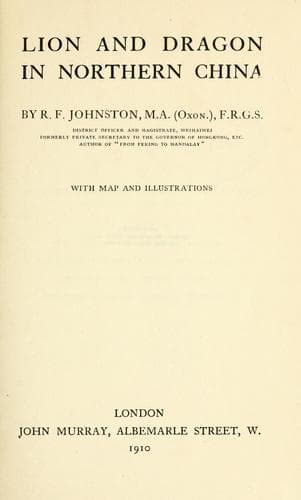
Lion and Dragon in Northern ChinaJohnston, Reginald Fleming, Sir
History
Lion and Dragon in Northern China
Johnston, Reginald Fleming, Sir
Weihai (China) -- History; Weihai (China) -- Social life and customs
So much for two out of the three solitary occasions on which Confucius
is said to have laid himself open to what Prof. Legge calls "the
most serious charge that can be brought against him, the charge of
insincerity." The events recorded in connection with the third occasion
are much more grave and deserve closer attention. The story goes that
Confucius when travelling to a place called Wei was captured by a
rebel-brigand of that state, who would only release him on condition
that he would take an oath to give up his proposed expedition to Wei.
Confucius took the oath, and on his release forthwith continued his
journey to the place he had sworn to avoid. On one of his disciples
asking him whether it was a right thing to break his word, Confucius
replied: "It was a forced oath. The spirits do not hear such." Now of
the moral question here involved Sir Robert Douglas takes the view that
it is "a nice question for casuists," but expresses the conviction that
by most people Confucius "will not be held to be very blameworthy for
that which, at the worst, was a mistaken notion of truthfulness."[268]
On the other hand many of us will hold the equally strong conviction
that if this story is true there is an ugly blot on the character of
Confucius. If he deliberately and knowingly broke his word, as this
story would indicate, then he was no gentleman.[269]
_Le bon sang ne pent mentir_, as the old French proverb says. Not
his can have been what Burke in thrilling words calls "that chastity
of honour, which felt a stain like a wound." But the evidence from
other sources that Confucius was a gentleman--a man to whom truth
and sincerity were very precious--is overwhelming. His teachings and
actions, so far as we know them--all but this one--prove conclusively
that he laid almost greater emphasis on truth and honour than on
any other quality. "Hold faithfulness and sincerity," he said, "as
first principles."[270] One of his English commentators remarks that
"the earnestness with which he insists on this, repeating the same
injunction over and over again, is a point in his teaching which is
well worthy of admiration."[271]
Public-domain text, read in full here on John Shaqi.
Reviews
Reviews
No reviews yet
Be the first to share your thoughts on this work.
Elsewhere in the archive
Join the Discussion
Join the discussion
Sign in to leave a comment or review.
Sign InorCreate an account