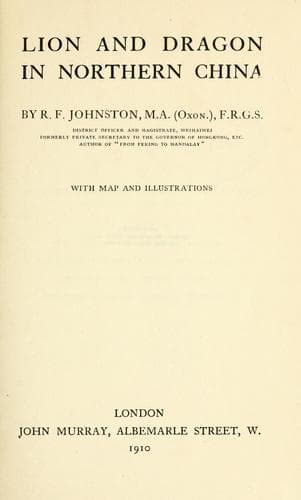
Lion and Dragon in Northern ChinaJohnston, Reginald Fleming, Sir
History
Lion and Dragon in Northern China
Johnston, Reginald Fleming, Sir
Weihai (China) -- History; Weihai (China) -- Social life and customs
If in Weihaiwei as elsewhere in rural China the influence of Confucius
is to be traced not in temples and religious or commemorative
ceremonial but in the customs, manners and character of the people, it
is clear that a description of the Confucianism of this corner of the
Empire would involve a repetition of much that has been already set
forth at length in the course of the foregoing pages. But there is a
feature of Confucianism that so far has been treated less thoroughly
than it deserves, although it constitutes by far the most important
element in the religious life of the people. This is the cult of
Ancestors.
There is perhaps a popular tendency in Europe (notwithstanding the
doctrines of Herbert Spencer) to regard this cult as something peculiar
to the Far East and without parallel in Western modes of religious
thought and practice: but, as students of comparative religion well
know, such is not the case. That ancestor-worship or something very
like it existed among the ancient Egyptians might be assumed from the
extraordinary measures which they took to preserve the bodies of the
dead: but we know from other evidence that the ancestral Ghost was
regularly approached with veneration and sacrifices. Cakes and other
articles were offered to the Egyptian _ka_ just as they are offered
to the spirits of the dead in China to-day; and, as in China, the
sacrificial ceremonies were made the occasion of family gatherings and
genial festivities.[280] Great religious revolutions have taken place
in Egypt in the course of ages, but among the Egyptian Mohammedans and
the Copts traces of ancestor-worship exist to this day. The evidence
at present available hardly justifies us in declaring that this cult
was also practised in Babylonia, though it seems at least certain that
heroes and distinguished men were deified and venerated. There is
less doubt about the early Israelites. "It is impossible to avoid the
conclusion," says the Rev. A. W. Oxford,[281] "that the pre-Jehovistic
worship was that of ancestors." He observes that "the importance
attached to a father's blessing before his death and the great fear
caused by a curse (Judges xvii. 2) were relics of the old cult of
ancestors."
The importance of the same cult in Greece and Rome can hardly be
exaggerated. In Greece, Zeus himself was regarded in one of his
aspects as πατρῷος, the ancestral god. "The central point of old Roman
religion," as Grant Allen has said,[282] "was clearly the household;
the family ghosts or _lares_ were the most honoured gods." In various
parts of the "Dark Continent" ancestor-worship is the prevailing
religion. "Nowhere," says Max Müller, "is a belief and a worship of
ancestral spirits so widely spread as in Africa."[283] That it existed
and still exists in many Eastern countries besides China need hardly
be emphasised. It is deeply embedded in Hinduism, and in Japan it has
grafted itself on Shinto.[284]
Public-domain text, read in full here on John Shaqi.
Reviews
Reviews
No reviews yet
Be the first to share your thoughts on this work.
Elsewhere in the archive
Join the Discussion
Join the discussion
Sign in to leave a comment or review.
Sign InorCreate an account