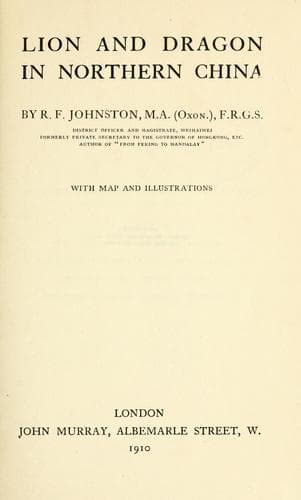
Lion and Dragon in Northern ChinaJohnston, Reginald Fleming, Sir
History
Lion and Dragon in Northern China
Johnston, Reginald Fleming, Sir
Weihai (China) -- History; Weihai (China) -- Social life and customs
It is perhaps of greater interest to Europeans to know that the
cult of ancestors existed in pre-Christian days in the forests of
old Germany. "Our early Teutonic forefathers," says Mr. F. York
Powell, "worshipped the dead and treated their deceased ancestors as
gods."[285] But old customs, especially religious ones, die hard; and
so we need not be surprised to find that just as the Isis and Horus of
the ancient Egyptians have become the Madonna and Child of the modern
Italians,[286] so the ancestor-worship of our Teutonic forefathers has
been transformed under Christian influences into solemn commemorations
of the dead, and masses for the souls of the "faithful departed." The
transformation, indeed, is in some places hardly complete to this day.
"Although full ancestor-worship," says Dr. Tylor, "is not practised
in modern Christendom, there remains even now within its limits a
well-marked worship of the dead. A crowd of saints, who were once men
and women, now form an order of inferior deities, active in the affairs
of men, and receiving from them reverence and prayer, thus coming
strictly under the definition of manes. This Christian cultus of the
dead, belonging in principle to the older manes worship, was adapted
to answer another purpose in the course of religious transition in
Europe."[287]
It appears that in one part of Christendom, at least, actual
ancestor-worship is not yet extinct. In backward parts of Russia at
this day, we are told, "the dead in return for the offerings are
supplicated to guard and foster the family and crops. 'Ye spirits
of the long departed, guard and preserve us well. Make none of us
cripples. Send no plagues upon us. Cause the corn, the wine, and the
food to prosper with us.'"[288] Evidently if ancestor-worship is
idolatrous, Europe is not without its idolatry even in this twentieth
century.
The Ancestral cult, as every one knows, received the hall-mark of
Confucius's approval, though Confucius himself did not profess to
be a theologian or to speak with authority on matters spiritual. It
is an extraordinary thing that Confucius's reticence with regard to
these matters has been selected by Christian missionaries as a subject
for special reproach. Prof. Legge, after quoting some of Confucius's
utterances on the subject of the unseen world, asks why he did not
"candidly tell his real thoughts on so interesting a subject,"[289] and
exclaims "Surely this was not the teaching proper to a sage." Elsewhere
he solves this question himself, for he decides that Confucius was
no sage.[290] Unfortunately he does not define the word Sage, though
he seems to imply that the word can be fittingly applied only to a
Christian teacher. He did not perhaps quite appreciate the significance
of the Horatian remark _Vixere fortes ante Agamemnona_.
Public-domain text, read in full here on John Shaqi.
Reviews
Reviews
No reviews yet
Be the first to share your thoughts on this work.
Elsewhere in the archive
Join the Discussion
Join the discussion
Sign in to leave a comment or review.
Sign InorCreate an account