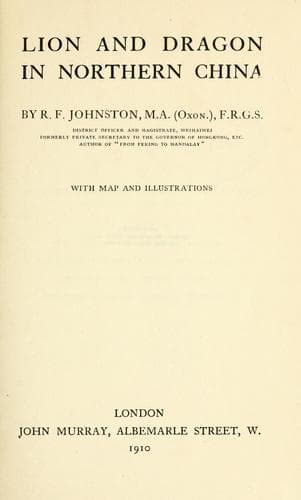
Lion and Dragon in Northern ChinaJohnston, Reginald Fleming, Sir
History
Lion and Dragon in Northern China
Johnston, Reginald Fleming, Sir
Weihai (China) -- History; Weihai (China) -- Social life and customs
The remarks made both orally and in writing on the subject of
Confucius and his religious views are often so framed as to convey the
idea, either that he was somehow to blame for his want of knowledge, or
that he really knew all the time about God and other spiritual beings,
but was deliberately and wickedly keeping the knowledge up his sleeve.
It is presumably for this reason that some missionaries have found it
their painful duty to explain to the Chinese (whom they are trying to
convert to a belief in a merciful and loving Deity) that Confucius
is now writhing in hell.[294] It is open to them to add that good
Chinese Christians may look forward to the happy day when they, from
their heavenly mansions, may behold their national Sage undergoing the
tortures prescribed for him in the nethermost regions: for was it not
Tertullian who, perhaps in a spirit of irony or mockery, declared[295]
that one of the joys of the blessed when they reach heaven will be
to watch the torments of the damned?[296] Fortunately bigotry and
intolerance of this kind are (thanks partly to secular pressure)
rapidly disappearing from Christian apologetics, but the charge against
Confucius that his views on spiritual matters were not only unsound
but were also discreditable to himself and to those who followed his
teachings, is still occasionally heard in the missionary camp.
It is perhaps worth while to consider briefly what those views were.
They are not to be found in any consecutive form; all one can do
is to pick up hints here and there and piece them together as best
one may. It must be remembered that Confucius seems very rarely to
have offered any remarks on spiritual matters on his own initiative:
he did not profess to be an authority on such subjects, and it was
only in answer to direct questions that he said anything at all. His
attitude may be compared with that of Mohammed, who administered
rebukes to his disciples when he heard them debating about fate and
destiny. Such things, he taught, were beyond all human knowledge. If
one might presume to construct a kind of paraphrase of Confucius's
occasional utterances on spiritual subjects, and put it in the form of
a continuous discourse, it might perhaps run somewhat as follows:
Public-domain text, read in full here on John Shaqi.
Reviews
Reviews
No reviews yet
Be the first to share your thoughts on this work.
Elsewhere in the archive
Join the Discussion
Join the discussion
Sign in to leave a comment or review.
Sign InorCreate an account