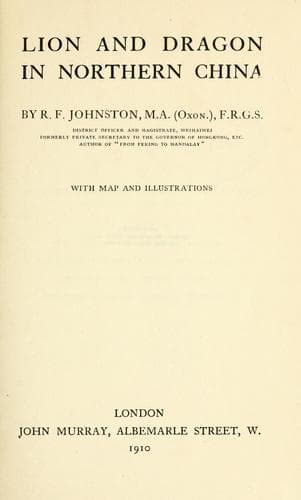
Lion and Dragon in Northern ChinaJohnston, Reginald Fleming, Sir
History
Lion and Dragon in Northern China
Johnston, Reginald Fleming, Sir
Weihai (China) -- History; Weihai (China) -- Social life and customs
Meadows remarks that every consistent Confucianist ought to be a blank
atheist, though probably he is using the word in the sense that used
erroneously to be attached to it a good many years ago,[291] when
"atheist" was the term applied to all persons who were outside the
Christian fold. In that sense Confucius was an atheist, and inasmuch
as he lived half a millennium before Christ was born it is obvious
that he could not possibly have been anything else. Mr. Arthur H.
Smith states that the mass of Confucian scholars are "thoroughly
agnostic and atheistic,"[292] though if these terms are correctly
used it is difficult to see how they could be both at the same time.
Mr. W. E. Griffis thinks it "more than probable" that Confucius laid
"unnecessary emphasis upon social and political duties, and may
not have been sufficiently interested in the honour to be paid to
Shang Ti or God. He practically ignored the Godward side of men's
duties."[293] Confucius would probably have said that if people fully
and completely discharge all their duties on the manward side they
need have no fear that they are neglecting the Godward side. Griffis
goes on to compare Confucianism with a child-headed giant, because it
is exaggerated on its moral and ceremonial side as compared with its
spiritual development. It must surely be clear to an unprejudiced mind
that Confucius deserves no blame whatever for omitting to lay down the
law on subjects about which he never professed to know anything. Men
have existed on this planet for tens of thousands of years: if, as
many occidental peoples hold, the Deity revealed Himself only nineteen
centuries ago, it is absurd to find fault with an honest philosopher
for not having known facts which had been preserved as a secret in
the archives of heaven for countless ages in the past and were to
remain undisclosed for another five hundred years in the future. Some
of us, perhaps, may be inclined to the opinion that the great secret
remains a secret still. "We are born to enquire after truth," said the
wise Montaigne; "it belongs to a greater power to possess it." But
supposing for the sake of argument that Truth, or a certain aspect of
Truth, came to man's knowledge by a miraculous act on the part of a
Divine Power nineteen centuries ago, one cannot blame Confucius for
not having obtained it from heaven five hundred years sooner. One
might as well blame St. Paul for not anticipating the astronomical
discoveries of Copernicus and Galileo, or St. Augustine for not telling
us how to deal with the modern Women's Suffrage problem, or the
Founder of Christianity Himself for not explaining the mechanism of
motor-omnibuses and aeroplanes. Prometheus is said to have succeeded
in wrenching a valuable secret from heaven without divine permission,
but Prometheus was a Titan and Confucius never pretended to be anything
more than a humble-minded man.
Public-domain text, read in full here on John Shaqi.
Reviews
Reviews
No reviews yet
Be the first to share your thoughts on this work.
Elsewhere in the archive
Join the Discussion
Join the discussion
Sign in to leave a comment or review.
Sign InorCreate an account