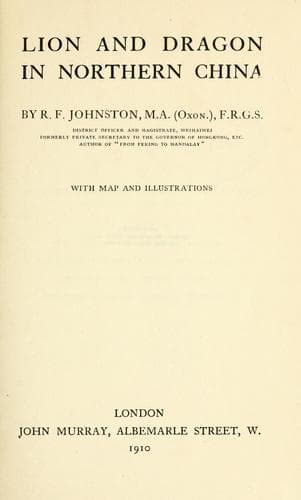
Lion and Dragon in Northern ChinaJohnston, Reginald Fleming, Sir
History
Lion and Dragon in Northern China
Johnston, Reginald Fleming, Sir
Weihai (China) -- History; Weihai (China) -- Social life and customs
Persons whose religion is bounded by dogmas and rituals, and who
take such a dismal view of human nature that they cannot conceive
of the existence of moral goodness apart from faith in a particular
creed, are always (consciously or unconsciously) on the look-out for
evidences of "sin" or imperfection or human frailty in the doctrines of
those who are ethical rather than religious teachers, and who do not
profess to have been favoured with a "divine revelation." Some of the
failings ascribed to Confucius--such as his alleged insincerity--have
been already dealt with; but if his Christian critics are unable to
substantiate their charges of moral depravity they are on much firmer
ground when they declare that Confucianism is not a religion at all,
but merely (though why "merely"?) a system of morals. This is a point
which every one will decide for himself in accordance with his own
views of what constitutes Religion. Cardinal Newman said that by
Religion he meant "the knowledge of God, of His Will, of our duties
towards Him." According to this definition Confucianism can hardly be
called a Religion. Carlyle said that whoever believes in the infinite
nature of Duty has religion. If this be so, it may after all be argued
that a religion is possessed by the true Confucian. Legge, who admired
Confucius as "a very great man," but was prompt to seek out evidence
that the Confucian system was altogether inferior to Christianity,
admitted that Confucianism was not "merely" a system of morality, but
also contained religion.[301] Sir Charles Eliot, on the contrary, says
"it has produced twenty centuries of gentlemen. Still, it is not in any
ordinary sense a religion."[302] Similarly Sir Thomas Wade declared
that the Chinese "have indeed a cult, or rather a mixture of cults,
but no creed." Hegel said that Religion is the Infinite Spirit of God
becoming self-conscious through the medium of the finite spirit. The
late Father Tyrrell held that what distinguishes religion from ethics
is "the belief in another world and the endeavour to hold intercourse
with it." Kant said that when moral duties are regarded as divine
commands, that is religion. Fichte said that religion was Knowledge
rather than morality. Matthew Arnold defined religion as "morality
touched with emotion." Schleiermacher said that religion consisted in
the consciousness of absolute dependence on a Power which influences us
though we cannot influence it in turn.
Public-domain text, read in full here on John Shaqi.
Reviews
Reviews
No reviews yet
Be the first to share your thoughts on this work.
Elsewhere in the archive
Join the Discussion
Join the discussion
Sign in to leave a comment or review.
Sign InorCreate an account