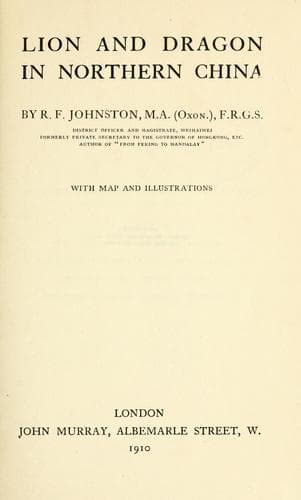
Lion and Dragon in Northern ChinaJohnston, Reginald Fleming, Sir
History
Lion and Dragon in Northern China
Johnston, Reginald Fleming, Sir
Weihai (China) -- History; Weihai (China) -- Social life and customs
[296] In nothing have we moved away from the pious savagery of a former
age more noticeably than in the average Christian's attitude towards
hell. "I don't believe in hell," is a very common observation nowadays
even on the part of those who assert themselves to be good Christians,
though surely from the Church's point of view the position is a highly
heretical one. Modern humanitarianism is gradually teaching the "plain
man" to see that if a heaven exists, and if human souls are to attain
to a condition of perfect happiness there, it is inconceivable that
there can be a hell also: for whatever the Christians of Tertullian's
day may have deemed necessary to happiness, few if any of us in
modern times could possibly (without undergoing a fundamental change
of character) attain complete happiness while in possession of the
knowledge that certain of our fellow human-beings were undergoing
eternal torment. The fact that we could ourselves behold the tormented
ones in their misery, so far from being an added source of pleasure
would surely turn our heavenly joys into dust and ashes. We cannot be
perfectly happy, as Prof. William James has remarked, so long as we
know that a single human soul is suffering pain. In a book entitled
_The Future Life and Modern Difficulties_, the Rev. F. C. Kempson
"does not hesitate to defend the belief that there are souls which are
finally lost, although he deprecates any materialistic presentation of
that state of loss." As his critic in the _Church Quarterly Review_
(April 1909, p. 200) sensibly points out, Mr. Kempson "does not fully
appreciate the depth of the objections against such a doctrine. To
many minds, not generally supposed to be tainted with sentimentality,
it appears that a universe where there was an ultimate loss of souls
through the complete determination of the will towards evil would be an
essentially atheistic universe, for it would be one in which the evil
was in the end partially triumphant over the good."
[297] "I don't know about the unseen world," said Thackeray in one of
his letters, "the use of the seen world is the right thing I'm sure. It
is as much God's world and creation as the kingdom of heaven with all
its angels."
[298] In some respects, it may be noted, Confucius's position is not
very far removed from that of some of the so-called Modernists of our
own time. Cf. Le Roy, _Dogme et Critique_ (4th ed.), p. 26; and the
late Father Tyrrell's _Lex Orandi_.
[299] _Lun Yü_, vii. 34.
[300] Mr. L. Giles, _The Sayings of Confucius_, p. 87.
CHAPTER XIV
CONFUCIANISM--II
Public-domain text, read in full here on John Shaqi.
Reviews
Reviews
No reviews yet
Be the first to share your thoughts on this work.
Elsewhere in the archive
Join the Discussion
Join the discussion
Sign in to leave a comment or review.
Sign InorCreate an account