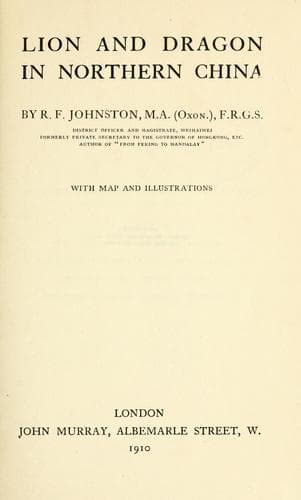
Lion and Dragon in Northern ChinaJohnston, Reginald Fleming, Sir
History
Lion and Dragon in Northern China
Johnston, Reginald Fleming, Sir
Weihai (China) -- History; Weihai (China) -- Social life and customs
It is very difficult, then, to know without precise definition what
is the exact meaning of those who declare that the Chinese make gods
of their dead fathers. Du Bose has condemned the Chinese ancestral
cult because it inculcates the worship of "parents once human but
now divine," and he quotes with apparent approval the words of
another writer who describes it as "one of the subtlest phases of
idolatry--essentially evil with the guise of goodness--ever established
among men."[304] Wells Williams says that Chinese ancestor-worship is
distinctly idolatrous; yet he admits that the rites consist "merely of
pouring out libations and burning paper and candles at the grave, and
then a family meeting at a social feast, with a few simple prostrations
and petitions ... all is pleasant, decorous, and harmonious ... and
the family meeting on this occasion is looked forward to by all with
much the same feeling that Christmas is in Old England or Thanksgiving
in New England."[305] So says the earnest American missionary; and
those of us who not only see nothing wrong in the Chinese ancestral
ceremonies but would be exceedingly sorry to see them abolished, will
perhaps feel inclined to smile at the reproachful terms in which he
refers to Sir John Davis, who had expressed the heterodox opinion that
the rites were "harmless, if not meritorious, forms of respect for the
dead."
Another American writer, well known as an authority on China, is
equally strongly opposed to any compromise with the cult of ancestors.
"It makes dead men into gods, and its only gods are dead men. Its
love, its gratitude, and its fears are for earthly parents only. It
has no conception of a Heavenly Father, and feels no interest in such
a being when He is made known. Either Christianity will never be
introduced into China or ancestral worship will be given up, for they
are contradictories. In the death struggle between them the fittest
only will survive."[306]
To show that this is not quite the view taken by all American
missionaries, let us quote the words of yet a third. Dr. W. A.
P. Martin, whose _Lore of Cathay_ is one of the most interesting
books of its kind on China yet produced, has a valuable chapter on
ancestor-worship in which he takes a much more liberal view than that
of his colleagues, though as a champion of Christianity he feels
himself obliged to find fault with "the transformation of the deceased
into tutelar divinities" and with "the invocation of departed spirits."
He admits that the ceremonies connected with the cult are of an
exceedingly impressive nature.
"The spectacle of a great nation," he says, "with its whole
population gathered round the altars of their ancestors, tracing
their lineage up to the hundredth generation, and recognising the
ties of kindred to the hundredth degree, is one that partakes of the
sublime."[307]
Public-domain text, read in full here on John Shaqi.
Reviews
Reviews
No reviews yet
Be the first to share your thoughts on this work.
Elsewhere in the archive
Join the Discussion
Join the discussion
Sign in to leave a comment or review.
Sign InorCreate an account