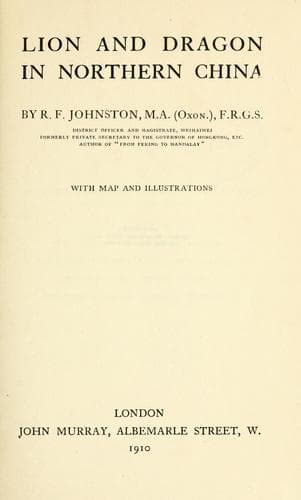
Lion and Dragon in Northern ChinaJohnston, Reginald Fleming, Sir
History
Lion and Dragon in Northern China
Johnston, Reginald Fleming, Sir
Weihai (China) -- History; Weihai (China) -- Social life and customs
Most of my readers are doubtless aware that it has been, and perhaps
still is, the custom of many missionaries to require their converts to
surrender their ancestral tablets, or to destroy them, as a proof of
their sincerity before baptism. There are many sad stories connected
with this cruel proceeding,[308] and it is refreshing to listen to the
frank confession of so experienced and fair-minded a missionary as Dr.
Martin, who admits that he himself once insisted on a convert giving up
his ancestral tablets, and has ever since regarded this as one of the
mistakes of his life, and looks back upon it with "poignant grief." As
he adds decisively, "I had no right to impose such a test," it is to be
hoped that his words have served as a warning to some, at least, of his
successors in the missionary field.
If Christianity is to win its way to the hearts of the Chinese people
it will probably have to condescend to a compromise on the question
of ancestor-worship. A recent writer in _The Spectator_ evidently
thinks it is the Chinese who will make all the compromise. "There is
no reason," he says, "why the Chinese, in accordance with their proved
mental habit, should not adopt a kind of metaphysical reading of
ancestor-worship such as would enjoy the hearty sanction of the Church
which preaches the 'Communion of Saints.'"[309]
It is indeed likely enough that as time goes on certain superannuated
features of ancestor-worship, as of other Chinese religious practices,
will gradually disappear, but it is probable that this will be due
rather to rationalistic pressure than to Christianity. The Chinese
are beginning to imbibe Western culture--especially Western science
and philosophy--with avidity, and the more they do so the more ready
will they be to abandon some of their traditional ideas with regard to
demonology, _fêng-shui_, the burning of paper furniture and money, the
worship of the "gods" of Taoism, and many other superstitious beliefs
and practices; indeed this lopping off of the rotten branches of the
religious life of China began several years ago, and is not likely
to cease until there are no more rotten branches left on the tree.
But it is a very noteworthy fact that the abandonment of many popular
superstitions does not necessarily imply the establishment of Christian
dogmas in their place.
Public-domain text, read in full here on John Shaqi.
Reviews
Reviews
No reviews yet
Be the first to share your thoughts on this work.
Elsewhere in the archive
Join the Discussion
Join the discussion
Sign in to leave a comment or review.
Sign InorCreate an account