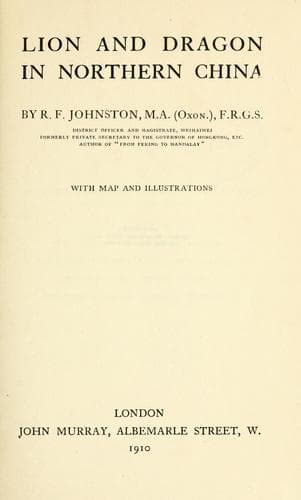
Lion and Dragon in Northern ChinaJohnston, Reginald Fleming, Sir
History
Lion and Dragon in Northern China
Johnston, Reginald Fleming, Sir
Weihai (China) -- History; Weihai (China) -- Social life and customs
If a Chinese goes to his _t'u ti_ (village "god") or to Kuan Yin or to
the Queen of Heaven (_Shêng Mu T'ien Hou_) or to Lung Wang the ruler of
clouds and water, with prayers for rain, or for the cure of disease,
or for safety from shipwreck; or if he beseeches the spirits of his
dead ancestors to protect the family and grant its members health and
prosperity, his proceedings are immediately condemned as idolatrous.
But if a Christian goes and prays to St. Hubert for an antidote to a
mad dog's bite or to St. Apollonia for a toothache-cure, or to St.
Theodorus at Rome for the life of a sick child, or to the Blessed
John Berchmans for the eradication of cancer in the breast, or to Our
Lady of Lourdes for the cure of a diseased bone, this is not idolatry
but good Christianity! As a matter of fact the ancestral spirits of
the Chinese and the great majority of the Taoist deities are neither
more nor less "gods" than the saints of Christendom. They--like the
saints--are regarded as the spirits of certain dead men who in their
new life beyond the grave are supposed to have acquired more or less
limited powers over some of the forces of nature and over certain of
the threads of human destiny. One is just as much a "god" as the other.
The Christian refuses to call his saints gods because that would be
confessing to polytheism, and as he professes to be a monotheist that
would never do; but he insists on accusing the Chinese of turning dead
men into gods because he wants to prove that the Chinese are idolatrous
and polytheistic.
If he says that he goes by the verdict of the Chinese themselves,
who apply to their dead men the title _shên_ and (in some cases) the
higher title _ti_, it is fair to remind him that if he insists upon
translating the former of these terms by the word "god" he should at
the same time supply a clear definition of the precise meaning which
that word is intended to convey; when he has done that it will be time
enough for us to consider whether the word "god" gives a fair idea
of the meaning of the Chinese when they declare that their deceased
ancestors have become _shên_. As to the supposed functions of the
Chinese "deities" and the Christian "saints," it would puzzle a keen
dialectician to say how the miracle-working of the one essentially
differs from that of the other, or how it is that St. Thomas of
Canterbury, in spite of his wonder-working bones, is a mere saint,
while Kuan Ti--who was once a stout soldier, but having been canonised
by imperial decree is now famous throughout the Chinese Empire as the
spiritual Patron of War--is to be hooted at as a false "god."[316]
Public-domain text, read in full here on John Shaqi.
Reviews
Reviews
No reviews yet
Be the first to share your thoughts on this work.
Elsewhere in the archive
Join the Discussion
Join the discussion
Sign in to leave a comment or review.
Sign InorCreate an account