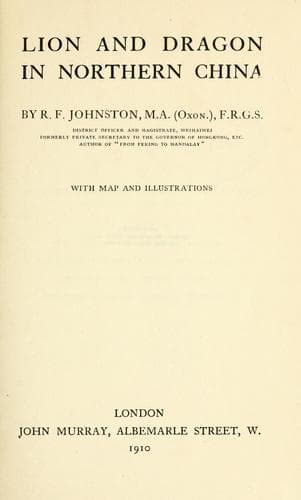
Lion and Dragon in Northern ChinaJohnston, Reginald Fleming, Sir
History
Lion and Dragon in Northern China
Johnston, Reginald Fleming, Sir
Weihai (China) -- History; Weihai (China) -- Social life and customs
It would seem that what the Christian says, in effect, is this: If the
Pope--the earthly head of our religion--canonises a dead man, that dead
man becomes a saint, and you may pray to him as much as you like; if
the earthly head of your religion--the Emperor of China--canonises a
man, he becomes a false god, possibly a demon, and if you commit the
sin of praying to him you do so on the peril of your soul. It is an
exemplification of the old saying, "Orthodoxy is my doxy, heterodoxy is
your doxy." In other words--you are right if you agree with me: if you
don't you are wrong! That was indeed a true saying of Thackeray's, "We
view the world through our own eyes, each of us, and make from within
us the things we see."
Of course there are many degrees of "godhead"--if we are to employ
that term--within the ranks of the Chinese "pantheon." The man
who, on account of his distinguished career in this world, or the
supposed miracles wrought by him since his removal to the next, has
been canonised or "deified" by imperial decree, holds a much more
important and imposing position than the ordinary father of a family
who, as it were, automatically becomes _shên_--a spirit or ancestral
divinity--through the simple and inevitable process of dying. But the
difference is rather in degree than in kind. The Emperor, as Father
of his people and as their High Priest or Pope, can raise any one he
chooses to the position of a _Ti_, and can subsequently elevate or
degrade him in the ranks of the national divinities in accordance
with his imperial will. As a matter of fact the process is intimately
connected with statecraft and considerations of practical expediency.
"In the Chinese Government," as Sir Alfred Lyall says, "the temporal
and spiritual powers, instead of leaning towards different centres,
meet and support each other like an arch, of which the Emperor's civil
and sacred prerogative is the keystone."[317]
Public-domain text, read in full here on John Shaqi.
Reviews
Reviews
No reviews yet
Be the first to share your thoughts on this work.
Elsewhere in the archive
Join the Discussion
Join the discussion
Sign in to leave a comment or review.
Sign InorCreate an account