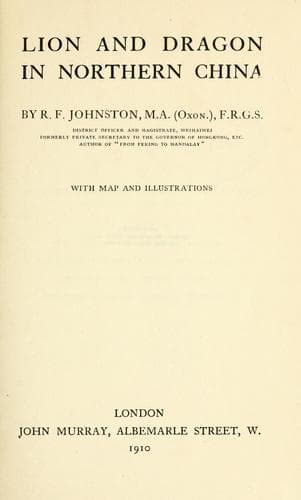
Lion and Dragon in Northern ChinaJohnston, Reginald Fleming, Sir
History
Lion and Dragon in Northern China
Johnston, Reginald Fleming, Sir
Weihai (China) -- History; Weihai (China) -- Social life and customs
It is a rather common opinion that "the worship of ancestors probably
had its origin in the fear of the evil which might be done by
ghosts."[321] Lafcadio Hearn, a devoted disciple of Herbert Spencer,
took a similar view of Japanese religion, and held that Shinto was at
one time a religion of "perpetual fear." Nobushige Hozumi, Dr. W. G.
Aston and others have disposed of this opinion with reference to Japan.
The former writer, who was called to the English Bar and subsequently
became a Professor of Law at Tokyo, and was still proud to own himself
an ancestor-worshipper, declared that "it was the love of ancestors,
not the dread of them, which gave rise to the custom of worshipping
and making offerings of food and drink to their spirits.... Respect
for their parents may, in some cases, have become akin to awe, yet it
was love, not dread, which caused this feeling of awe.... We celebrate
the anniversary of our ancestors, pay visits to their graves, offer
flowers, food and drink, burn incense, and bow before their tombs
entirely from a feeling of love and respect for their memory, and no
question of 'dread' enters our minds in doing so."[322]
So far as I have had opportunities of judging of Chinese
ancestor-worship, I am strongly of opinion that, subject to what has
been said in an earlier chapter,[323] the words of this writer are as
applicable to China as they are to Japan.[324] There seems, indeed, to
be very little reason why any one should propound or hold the theory
that a loving father was liable to turn into a malevolent ghost. What
the Chinese believe is that their deceased ancestors are well-disposed
towards them, and will give them reasonable help and protection
throughout the course of their lives: though if the ancestral graves
are left uncared-for or the periodical sacrifices neglected or the
spirit-tablets not treated with respect, or if living members of
the family have wasted the family property or have been guilty of
discreditable conduct, then no doubt the spirits will be angry and will
punish them for the crime of lack of filial piety (_pu hsiao_), the
worst crime of which a Chinese can be guilty.
Public-domain text, read in full here on John Shaqi.
Reviews
Reviews
No reviews yet
Be the first to share your thoughts on this work.
Elsewhere in the archive
Join the Discussion
Join the discussion
Sign in to leave a comment or review.
Sign InorCreate an account