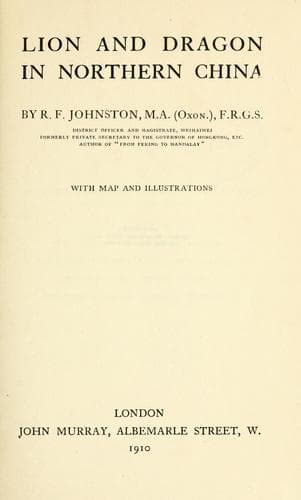
Lion and Dragon in Northern ChinaJohnston, Reginald Fleming, Sir
History
Lion and Dragon in Northern China
Johnston, Reginald Fleming, Sir
Weihai (China) -- History; Weihai (China) -- Social life and customs
The Chinese are quite satisfied that so long as they behave in a
filial manner (the word "filial" being taken in its widest possible
signification) they have nothing whatever to fear from their ghostly
ancestors. To be truly filial a Chinese must not merely behave with
dutiful obedience towards his parents when they are alive and with
dutiful reverence towards their manes when they are dead, but he must
also act in such a way as to reflect no speck of discredit upon them by
his own misdeeds. If his parents are themselves guilty of wrongdoing he
is entitled to remonstrate with them, because after all his parents as
well as himself owe filial reverence to their common ancestors. If the
wrongdoing is all his own he is twice guilty, for he has committed an
action which is in itself intrinsically wrong, and by degrading his own
moral nature he has brought disgrace on his parents. According to this
theory, the Chinese who commits a dishonourable action is unfilial;
if he breaks the law he is unfilial; if he does not discharge all his
dead father's obligations he is unfilial; if he ruins his own health
through immorality or excesses of any kind he is unfilial; if he fails
to bring up legitimate offspring (to continue the family and carry on
the ancestral rites) he is unfilial.[325]
Needless to say there is no such person as a perfectly filial son in
all China--or anywhere else in the world for that matter: but that fact
no more justifies us in attempting to disparage the noble and lofty
Chinese ideal of filial piety than the failure of Christian men and
Christian Governments to act in accordance with the doctrines of the
Sermon on the Mount justifies us in disparaging the highest ethical
ideal of Christianity. If the ideal--in either the Christian or the
Chinese system--were actually attainable, it would become necessary to
form a new ideal to take the place of that which had ceased as such to
exist or had been seen to "fade into the light of common day." Some
Western observers are apt to think that the Chinese doctrine of filial
piety is too one-sided to be practical: that it makes the son the slave
of his parents and gives the parents at the same time the position of
irresponsible tyrants. No greater mistake could possibly be made. The
responsibilities of the parent are correlative to the duties of the
child.
The _locus classicus_ for this is a famous story told of Confucius
himself. When he was Minister of Crime in his native state a father
brought an accusation against his own son. Confucius sent them both to
gaol, and when he was questioned as to why he punished the father as
well as the son and did not rather condemn the son for the gross crime
of disobeying his father, he replied thus: "Am I to punish for unfilial
conduct one who has not been taught filial duties? Is not he who fails
to teach his son his duties equally guilty with the son who fails to
fulfil them?"[326]
Public-domain text, read in full here on John Shaqi.
Reviews
Reviews
No reviews yet
Be the first to share your thoughts on this work.
Elsewhere in the archive
Join the Discussion
Join the discussion
Sign in to leave a comment or review.
Sign InorCreate an account