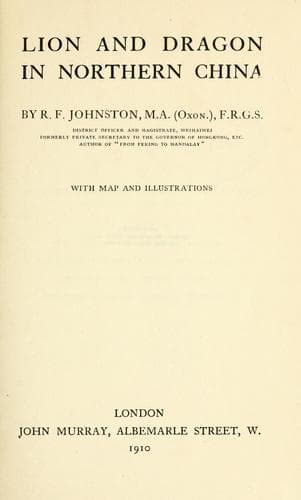
Lion and Dragon in Northern ChinaJohnston, Reginald Fleming, Sir
History
Lion and Dragon in Northern China
Johnston, Reginald Fleming, Sir
Weihai (China) -- History; Weihai (China) -- Social life and customs
"As a system, ancestral worship," says a European writer, "is tenfold
more potent for keeping the people in darkness than all the idols in
the land." "By its deadening influences," says another, "the nation has
been kept for ages looking backward and downward instead of forward
and upward."[331] A few years ago, be it repeated, the theory was one
that had some weight: not because it was convincing in itself but
because facts were wanting by which it could be refuted. The leap of
Japan into the front rank of civilised nations has for ever disposed of
the argument that ancestor-worshippers are necessarily impervious to
change and reform. The cult of ancestors, be it remembered, is nearly
if not quite as prominent a feature in the religious life of Japan as
in that of China. Says a foreign observer, "The ancestor-worship of
the Japanese is no superstition: it is the great essential fact of
their lives."[332] Says a native observer, "the introduction of Western
civilisation, which has wrought so many social and political changes
during the last sixty years, has had no influence whatever in the
direction of modifying the custom."[333]
According to Lafcadio Hearn, ancestor-worship is "that which specially
directs national life and shapes national character. Patriotism belongs
to it. Loyalty is based on it." Little wonder is it that, knowing what
the ancestral cult has done for Japan, Prof. H. A. Giles in quoting
this passage adds a significant remark. "It would seem," he writes,
"that so far from backing up missionaries who are imploring the Chinese
to get rid of ancestral worship, the sooner we establish it in this
country the better for our own interests." That ancestor-worship can be
introduced or reintroduced into an occidental country in the twentieth
century is of course out of the question: but before we continue to
devote human lives and vast treasure to the self-imposed task of
uprooting it from its congenial oriental soil, would it not be well
earnestly to consider whether our work may not be regarded by our own
distant posterity as the most stupendous folly or as the gravest and
most disastrous of errors ever committed by the nations of the West?
By all means let it be admitted that ancestor-worship helped to make
China content--perhaps foolishly content--with her traditional culture,
and too heedless of the rapid development of the occidental Powers in
wealth and civilisation and scientific equipment: on the other hand
it helped to make her people industrious, frugal, patient, cheerful,
law-abiding, filial, good fathers, loyal to the past, hopeful and
thoughtful for the future. Most emphatically may we say this, that
it is not essential to China's future progress that ancestor-worship
should be abolished. Among the people of China their ancestors occupy
the place of a kind of Second Chamber--a phantom House of Lords,
strongly antagonistic to sudden change and to rash experiments whether
Public-domain text, read in full here on John Shaqi.
Reviews
Reviews
No reviews yet
Be the first to share your thoughts on this work.
Elsewhere in the archive
Join the Discussion
Join the discussion
Sign in to leave a comment or review.
Sign InorCreate an account