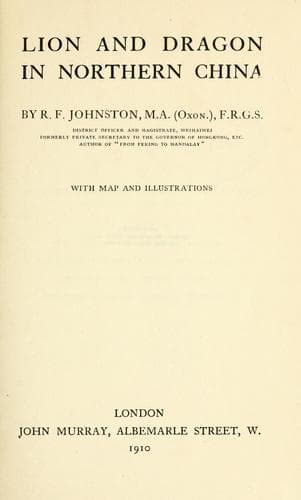
Lion and Dragon in Northern ChinaJohnston, Reginald Fleming, Sir
History
Lion and Dragon in Northern China
Johnston, Reginald Fleming, Sir
Weihai (China) -- History; Weihai (China) -- Social life and customs
This of course is carrying the theory of the mutual responsibilities
of father and son, ruler and ruled, a great deal too far: but
occurrences of this kind will become less and less frequent with
the gradual advance of scientific and general knowledge; and it is
surely far better that the changes should occur automatically than by
forcible interference with customs and superstitions which in their
fall might involve the indiscriminate destruction of good and bad. We
may now perceive, perhaps, how it was that Confucius, who was evidently
almost an agnostic with regard to gods and spiritual beings,[330] was
strenuously opposed to the abandonment of the rites and ceremonies
that presupposed the existence of such beings. He insisted upon the
importance of keeping up the cult of ancestors not so much for the sake
of the dead but because it fostered among living men feelings of love,
respect, reverence, and duty towards family and State. The souls of
the dead might or might not be unconscious of what was done for them,
but it was in the interests of social harmony and political stability
that the traditional religious and commemorative ceremonies should be
jealously preserved and handed down to posterity and that during the
performance of such ceremonies the presence of the ancestral spirits
should at least be tacitly assumed.
There is one alleged objection to ancestor-worship which only a few
years ago might have been regarded as most serious; and indeed it has
been urged again and again by missionaries, travellers, ethical writers
and sociologists. It was supposed that the cult of ancestors kept the
race that practised it in the grip of a remorseless conservatism;
that the ancestor-worshipper always turned his back on progress and
reform on the plea that what was good enough for his grandfather was
good enough for him; that ancestor-worship was the secret of Oriental
stagnation, and that no Eastern race could be expected to advance in
civilisation and culture until it had learned to work for the good of
its posterity rather than for the barren honour of its ancestry.
Public-domain text, read in full here on John Shaqi.
Reviews
Reviews
No reviews yet
Be the first to share your thoughts on this work.
Elsewhere in the archive
Join the Discussion
Join the discussion
Sign in to leave a comment or review.
Sign InorCreate an account