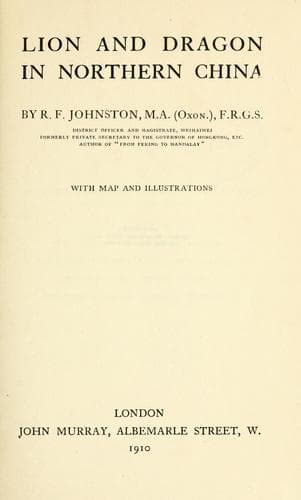
Lion and Dragon in Northern ChinaJohnston, Reginald Fleming, Sir
History
Lion and Dragon in Northern China
Johnston, Reginald Fleming, Sir
Weihai (China) -- History; Weihai (China) -- Social life and customs
It is not only Confucianism, with its grand ethical system, its
acquiescence in Nature-worship and its cult of ancestors, that has
built up the curiously unsymmetrical edifice of Chinese religion.
Taoism and Buddhism must also be taken into account; and if one can
find for them but few words of praise it is only fair to remember
that the Taoism of to-day has very little in common with the lofty
if sometimes rather misty speculations enshrined in that remarkable
old classic the _Tao Tê Ching_, and that Buddhism--as now practised
in north-eastern Shantung and indeed in the greater part of China
(excluding certain famous monastic centres)--is perhaps irrevocably
degenerate and corrupt. The _Tao Tê Ching_, the sacred book of Taoism,
is generally supposed, probably on insufficient grounds,[334] to have
been written by a philosopher known as Lao Tzŭ, said to have been an
elder contemporary of Confucius, in the sixth century B.C.
The Taoist philosophy, as set forth in that book, may or may not have
been indigenous to China; some writers insist that it was wholly a
product of Chinese speculation,[335] while others trace it to early
Indian philosophy[336] and even connect it with Buddhism.[337] Though
its doctrines are metaphysical as well as ethical, Taoism is to some
extent comparable with Confucianism, in which the ethical element is
predominant. Indeed most writers have admitted that in enunciating
the noble doctrine "Return good for evil," Lao Tzŭ rose to a height
never quite attained by Confucius, though the latter also anticipated
Christianity by formulating a version of the Golden Rule. One of the
best outline comparisons ever attempted between the two systems of
Taoism and Confucianism is that recently made by a sympathetic American
writer,[338] who concludes with the carefully-weighed and highly
important utterance that the two codes combined "furnished at once the
foundation and superstructure of as pure, high, and at the same time
practical system of ethics as the world has ever seen. It need fear
comparison with none. Even that laid down in the Bible, if carefully
separated from the religious element here and there intermingled with
it, can do no more for man than this ancient system of the Far East can
do. And why should it be otherwise, since the two are similar almost to
identity, and are, as has been claimed, the necessary outgrowth of the
same human spirit."
Public-domain text, read in full here on John Shaqi.
Reviews
Reviews
No reviews yet
Be the first to share your thoughts on this work.
Elsewhere in the archive
Join the Discussion
Join the discussion
Sign in to leave a comment or review.
Sign InorCreate an account