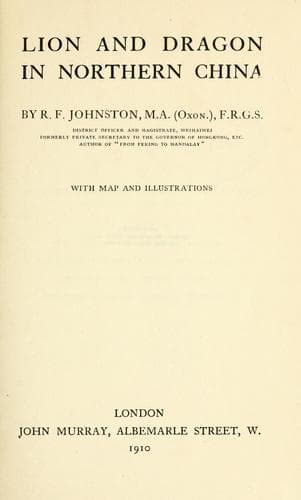
Lion and Dragon in Northern ChinaJohnston, Reginald Fleming, Sir
History
Lion and Dragon in Northern China
Johnston, Reginald Fleming, Sir
Weihai (China) -- History; Weihai (China) -- Social life and customs
There is no better augury for future good relations between the
thinkers and scholars (if not the Governments and peoples) of East
and West than the recent growth of a tolerant and generous spirit on
the part of European students of oriental ethic and religion. One
still hears constantly of "heathen" and "pagan"--words which, however
inoffensive in their original meaning, have come to be regarded as
somewhat opprobrious epithets; but that there is a very decided change
for the better coming over missionary enterprise in China can be proved
very simply by a comparison between the sympathetic appreciation shown
in the passage from which the above statement is quoted (written, be
it noted, by one who is keenly interested in missionary work in China)
and the almost inconceivable bigotry and narrow-mindedness shown by
many missionary writers only a few years ago. Even Dr. Legge, the
laborious and conscientious translator of the Chinese classics, allowed
his Christian prepossessions, as we have already seen, to obscure
his judgment and stultify his conclusions. "Their sages, _falsely so
called_," is how he refers to some of the greatest ethical teachers the
world has seen.[339] "In January, 1882," writes a doctor of divinity,
"a distinguished missionary in China attacked Max Müller as a foe to
missions and as a heathen because he had instituted the series of
translations of the Sacred Books of the East. The translation itself
was an offence; but the use of the title _Sacred_ definitely fixed
Müller's status. Moreover, at even a later date, some missionaries in
answer to the query from Chinamen 'Where now is Confucius?' were prompt
to reply 'In hell.'"[340]
The missionaries of to-day (let us hope against hope that there are no
exceptions) have abandoned their old savage belief that the "heathen"
as such are destined for eternal damnation. This change of belief is of
itself sufficient to revolutionise the attitude of Christian peoples
towards those who are not Christians, and surely it makes the need of
proselytising the "heathen" infinitely less urgent than it seemed to be
when that theory still held sway. "If God be father of all," writes a
missionary of fourteen years' standing in China, "it is as impossible
to believe in the Bible as the sole written depository of the Spirit
of God as in the condemnation of the heathen which once we were
constrained to believe it taught."[341]
Public-domain text, read in full here on John Shaqi.
Reviews
Reviews
No reviews yet
Be the first to share your thoughts on this work.
Elsewhere in the archive
Join the Discussion
Join the discussion
Sign in to leave a comment or review.
Sign InorCreate an account