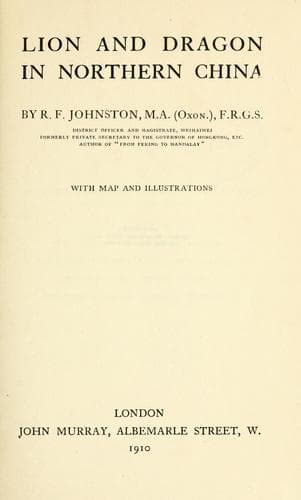
Lion and Dragon in Northern ChinaJohnston, Reginald Fleming, Sir
History
Lion and Dragon in Northern China
Johnston, Reginald Fleming, Sir
Weihai (China) -- History; Weihai (China) -- Social life and customs
waters became ever more and more defiled by the foulness and refuse of
the plains. Perhaps it would be equally true to say that the source
of the river of popular Taoism lies among the mists and marshes of
some trackless and pestilential jungle; that its waters throughout the
whole of its visible course are muddy and impure; and that the clear
mountain stream that flowed from the doctrines of Lao Tzŭ and his
interpreters and successors was only a tributary stream whose crystal
waters were soon lost in the turbid flood of the main river. It was a
clear perception of the fundamental difference between the philosophy
of Lao Tzŭ and popular Taoism that induced a recent Japanese writer,
Kakasu Okakura, to confer upon the former the name of Laoism, after its
founder, and to relinquish to the latter the barren glory of the name
of Taoism;[344] thus in contemplating the unattractive mythology and
crude rituals of the Taoism of the temples we must beware of laying
any of the responsibility for such follies on the grand though shadowy
figure of "the Old Philosopher," in spite of the fact that his image
has taken its place in the Taoist Trinity of gods who are supposed to
reign (though not to rule) over the phenomenal Universe.
If it can be confidently asserted that the people of Weihaiwei know
little or nothing of Laoism, it must be admitted that they still cling
with apparent fondness to the puerile imaginings of Taoism. In respect
of Confucianism they perform (with zeal and sincerity) the traditional
rites of ancestor-worship, and with respect to Buddhism they support
(with less zeal and less sincerity) a few priests to burn incense for
them on stated days before the image of the Buddha or some favourite
_p'u-sa_ such as the "Goddess of Mercy": but in other respects Taoism
may be said to be the religion that monopolises the largest share of
their attention. The greater number of temples in the Territory are
Taoist--excluding the Ancestral Temples (_Chia Miao_), which are not
open to the public. Most of these Taoist edifices are poor in outward
appearance and their interiors are often dirty and evil-smelling; while
the images of the numerous Taoist deities are of cheap manufacture and
tawdry in ornament. A casual visitor might suppose the gods were left
entirely to themselves; for he may go through a dozen temples and not
find a single worshipper or a single priest. But if he scrutinises
the altars he will find, amid the dust and cobwebs, the ashes of
incense-sticks and sometimes the remains of little offerings in the
shape of cakes or sweetmeats,--just enough to show that the gods are
not quite forgotten. It is only the largest temples that have resident
priests; the smaller ones are either in charge of apprentices or
pupil-priests or are visited from time to time (as on occasions of
annual festivals or theatrical shows) by priests who exercise spiritual
superintendence over a group of temples scattered over a considerable
area.
Public-domain text, read in full here on John Shaqi.
Reviews
Reviews
No reviews yet
Be the first to share your thoughts on this work.
Elsewhere in the archive
Join the Discussion
Join the discussion
Sign in to leave a comment or review.
Sign InorCreate an account