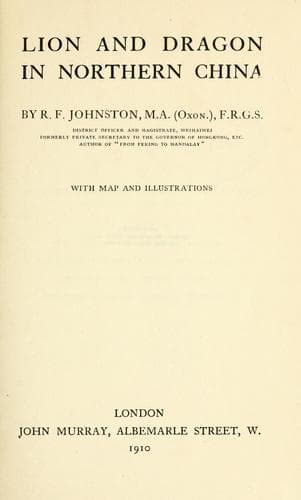
Lion and Dragon in Northern ChinaJohnston, Reginald Fleming, Sir
History
Lion and Dragon in Northern China
Johnston, Reginald Fleming, Sir
Weihai (China) -- History; Weihai (China) -- Social life and customs
It is perhaps more necessary to lay emphasis on the value of pure
Taoism as an ethical system than on that of the Confucian code, for
one is apt--especially if one lives among the Chinese--to condemn
Taoism almost unheard on account of the gross superstitions that
characterise it at the present day. Popular Taoism is and for many
centuries has been a compound of jugglery and fraud, of pseudo-religion
and pseudo-philosophy. With all this Lao Tzŭ had nothing to do. That
great man and his brilliant successor Chuang Tzŭ--who has been styled
the St. Paul of Taoism--founded their theory of life and conduct on
a mysterious entity called _Tao_, a word which has been variously
translated Reason, Realisation, the Norm, the Word (λόγος), the Way,
the First Cause, Nature, the Idea of the Good (in the Platonic sense),
the Creative Principle, Truth, the Metaphysical Absolute, Virtue,
Wisdom, God. This is no place for a discussion of the philosophical
principles of pure Taoism, which has no visible existence among the
farmers of Weihaiwei. All that need be said here is that to understand
Tao and to regulate one's life according to Tao was to be a _chên-jên_,
a true man, a Taoist.
As time went on Taoism became ninety-nine parts "ism" to one part
Tao: it dabbled in alchemy, fortune-telling and astrology, and its
votaries (who included several Chinese emperors) gave themselves up to
a search for the elixir of immortality and the elusive secret of the
transmutation of metals. The torch of a lofty philosophy passed into
the hands of men who, instead of using the light to aid them in the
search for the sublime _Tao_, soon quenched it in the stagnant waters
of witchcraft and demonology. Some writers seem to have assumed that
Lao Tzŭ, in spite of the acknowledged fact of his intellectual and
moral greatness, was in some mysterious way the unwitting cause of the
later corruptions: but, as has been said, a clear distinction must be
drawn between popular Taoism (which has little or nothing to say of
_Tao_) and the philosophic Taoism which has made a noble and permanent
contribution to the ethical consciousness of the Chinese people.[342]
Popular Taoism probably existed, in some form or other, long before
the time of the compiler of the _Tao Tê Ching_. The astrology and
alchemy and demonology that give the former many of its characteristic
features may have existed in China from a very remote age. The extreme
antiquity of superstitions of this kind in other parts of Asia is an
undeniable fact: the records of the early civilisation of Chaldæa give
us statements concerning the sorcerers and astrologers of that country
that might be applied almost without alteration to the charm-mongerers
and adepts of Chinese Taoism.[343] The philosophy of Lao Tzŭ may be
compared with a pure sparkling stream that bubbled up amid the crags
of a lofty range of mountains; when it had flowed down the hillside
and began to meander through the fields and villages below, its limpid
Public-domain text, read in full here on John Shaqi.
Reviews
Reviews
No reviews yet
Be the first to share your thoughts on this work.
Elsewhere in the archive
Join the Discussion
Join the discussion
Sign in to leave a comment or review.
Sign InorCreate an account