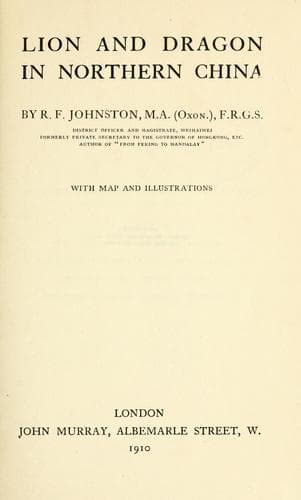
Lion and Dragon in Northern ChinaJohnston, Reginald Fleming, Sir
History
Lion and Dragon in Northern China
Johnston, Reginald Fleming, Sir
Weihai (China) -- History; Weihai (China) -- Social life and customs
The dynasty founded by the "First Emperor" divided the whole Empire as
it then was into thirty-six _chün_ or provinces, and Wên-têng formed
part of the Ch'i province. At last, in the sixth year of Kao Tsu of the
Han dynasty (201 B.C.), a Chinese magisterial district was founded in
the eastern peninsula for the first time, though the city chosen as the
centre of government was not Wên-têng but a place called Pu-yeh-ch'êng,
and the _hsien_ or magisterial district was accordingly known as
Pu-yeh-Hsien. This city, which is said[28] to have been founded by one
Lai-tzŭ in the "Spring and Autumn" period twenty-five centuries ago,
is now a small village in the modern Jung-ch'êng district, a short
distance from the British frontier on the Chinese side, and whatever
glory it may once have possessed has totally departed. The origin
of the name, which means "Nightless," is unknown, though naturally
one would like to connect it in some way with the Sunlit Vale of the
astronomer Ho. The new _hsien_ city was assigned to the prefecture of
Tung-lai, then the most easterly prefecture in the province.
From this time onward all the north-eastern part of Shantung, including
the districts with which we are specially concerned, remained under the
civil administration of China. From time to time various changes were
made in the seat of district-government and in the boundaries of the
prefectures, but these it would be superfluous to follow in detail. In
the fourth year of T'ien T'ung (568 of our era), Wên-têng city became
the magistrate's headquarters, and the district was placed in the
Ch'ang-kuang prefecture under the name of Wên-têng-shan Hsien. Early in
the period K'ai Huang (581-600), the abolished Ch'ang-kuang prefecture
gave place to Mou Chou, and Wên-têng was placed in the Tung-lai
prefecture, to which Pu-yeh had formerly been assigned. Passing over
many similar administrative changes of no special significance we come
to the Ming dynasty, which began to reign in 1368. In the ninth year of
Hung Wu (1376) the present prefecture of Têng-chou was created. Both
Wên-têng and Ning-hai districts were assigned to the new prefecture and
have remained under its jurisdiction ever since.
Public-domain text, read in full here on John Shaqi.
Reviews
Reviews
No reviews yet
Be the first to share your thoughts on this work.
Join the Discussion
Join the discussion
Sign in to leave a comment or review.
Sign InorCreate an account