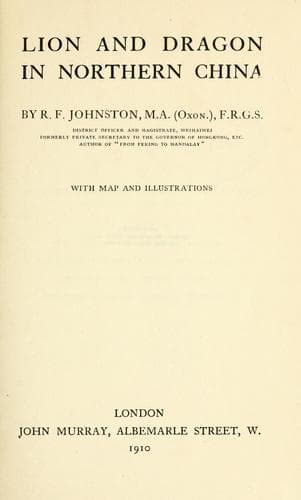
Lion and Dragon in Northern ChinaJohnston, Reginald Fleming, Sir
History
Lion and Dragon in Northern China
Johnston, Reginald Fleming, Sir
Weihai (China) -- History; Weihai (China) -- Social life and customs
The last year or two of the Ming dynasty (1642-3) was a troublous and
anxious time for all peace-loving Chinese. The events that led to the
expulsion of the Mings and the establishment of the present (Manchu)
dynasty on the Chinese throne are too well known to need detailed
mention. A great part of the Empire was the prey of roving bands of
rebels and brigands, one of whom--a remarkable adventurer named Li
Tzŭ-ch'êng--after repeatedly defeating the imperial troops finally
made himself master of the city of Peking. The last Emperor of the
Ming dynasty, overwhelmed with shame and grief, hanged himself within
the palace grounds. The triumph of Li was short-lived, for the warlike
tribes of Manchuria, readily accepting an invitation from the Chinese
imperialist commander-in-chief to cross the frontier and drive out the
presumptuous rebels, soon made themselves supreme in the capital and
in the Empire. The condition of the bulk of the Chinese people during
this time of political ferment was pitiable in the extreme. Military
leaders, unable to find money to pay their troops, neither could nor
would prevent them from committing acts of pillage and murder. Bands
of armed robbers, many of them ex-soldiers, roamed over the land
unchecked, leaving behind them a trail of fire and blood.
Confining our attention to the districts with which we are specially
concerned, we find that a band of brigands took by assault the walled
city of Ch'êng-shan, while at Weihaiwei the conduct of the local
troops was so disorderly that civilians with their wives and families
had to abandon their fields and homes and flee for refuge to the
tops of hills.[33] The _chih-hui_ in command of the local Wei at
this momentous time, coming to the conclusion that the dynasty was
tottering and that the seals of office issued by the Ming Emperors
would shortly bring disaster on their possessors, deserted his post
and sought a dishonoured refuge at home. It was not for several years
afterwards that the distracted people of Weihaiwei, or such of them
as had survived the miseries of those terrible days, once more found
themselves in possession of their ancestral farms and reasonably secure
from rapine and outrage.
Public-domain text, read in full here on John Shaqi.
Reviews
Reviews
No reviews yet
Be the first to share your thoughts on this work.
Join the Discussion
Join the discussion
Sign in to leave a comment or review.
Sign InorCreate an account