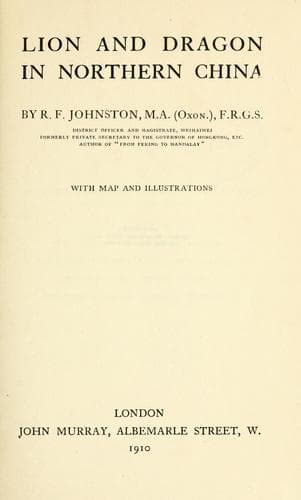
Lion and Dragon in Northern ChinaJohnston, Reginald Fleming, Sir
History
Lion and Dragon in Northern China
Johnston, Reginald Fleming, Sir
Weihai (China) -- History; Weihai (China) -- Social life and customs
Wang Yüeh of the Ming dynasty passed a very good examination and
was appointed a district-magistrate. For nine years he received no
promotion, so he threw up his official post and came home whistling
and singing with delight at having got his freedom. Among his writings
are "Records of Southern Travel" and a description of Weihaiwei. The
latter takes the form of an imaginary dialogue between a stranger from
Honan and a Weihaiwei native.[45] It is too long to translate in full,
but it begins thus: "From the far west came a stranger. Here at Weihai
he rested awhile, and as he gazed at the limitless expanse of hills
and ocean his feelings expressed themselves now in deep sighs, now
in smiles of happiness. Summoning to his side a native of Weihai he
introduced himself thus: 'I come from the province of Honan. No rich
man am I, yet I love to wander hither and hither, wherever there are
wonderful places or beautiful scenery to be visited. I have seen the
sacred hills of Hêng, Sung, Hua and T'ai;[46] the famous rivers and
lakes of the Empire, the Yangtse and the Han, the Tung-t'ing lake, the
Hsiang river, have all been visited by me, all their points of interest
examined and all their beauties seized. But methought that the great
ocean I had not yet seen, for it lay far to the east.'" He goes on to
describe by what route and under what difficulties he travelled, and "I
don't know how many thousand _li_ I haven't come," he said plaintively;
"my horse is weary and his hoofs are worn, my servant is in pain
with swollen ankles, and just see what a pitiable sight I am with my
tortured bones and muscles! However, here we are at last, and all I
want to do is to gain new experiences and behold new scenes, and so
remove all cause of future regret for things not seen."
The Weihai man points out to the stranger the various features of
interest of the place and gives a sketch of its history, and the
narration ends up with his loyal wishes for the eternal preservation of
his country and the long life of the Emperor.
Yüan Shu-fang took his degree in 1648 and received an appointment
in Yang-chou,[47] where he fulfilled his official functions with
wisdom and single-mindedness. He was fond of travelling about in the
south-eastern provinces and attracted round him numbers of people of
artistic temperament. After many years, continues his biographer, he
retired from the civil service and went home to Weihaiwei. There he
gave himself up with the greatest enthusiasm to the luxury of poetic
composition. Among his poems are "Songs of the South." He edited
and annotated the _Kan Ying P'ien_ [the Taoist "Book of Rewards and
Punishments"] and other works of that nature. A little poem of his
on the view of Liukungtao from the city wall is given a place in the
_Weihaiwei Chih_.
Public-domain text, read in full here on John Shaqi.
Reviews
Reviews
No reviews yet
Be the first to share your thoughts on this work.
Elsewhere in the archive
Join the Discussion
Join the discussion
Sign in to leave a comment or review.
Sign InorCreate an account