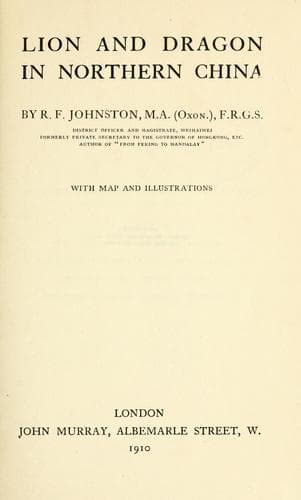
Lion and Dragon in Northern ChinaJohnston, Reginald Fleming, Sir
History
Lion and Dragon in Northern China
Johnston, Reginald Fleming, Sir
Weihai (China) -- History; Weihai (China) -- Social life and customs
The number of Chinese officials who, like Wang Yüeh or Yüan Shu-fang,
have been glad to divest themselves of the cares and honours
of office under Government is surprisingly large. Disappointed
ambition; constitutional dislike of routine employment, official
conventionalities and "red tape"; a passion for the tranquil life of
a student; a love of beauty in art or nature: these, or some of them,
are the causes that have impelled multitudes of Chinese officials to
resign office, often early in their careers, and seek a quiet life
of scholarly seclusion either in their own homes or in some lonely
hermitage or some mountain retreat. Even at the present day retired
magistrates may be met with in the most unexpected places. I found
one in 1908 living in a little temple at the edge of the stupendous
precipice of Hua Shan in Shensi, eight thousand feet above the
sea-level. He was a lover of poetry and a worshipper of Nature.
Ting Pai-yün was for some time a resident in but not a native of
Weihaiwei. His personal name and native place are unknown. It is said
that he obtained the doctorate of letters towards the end of the
Ming period. His first official post was at Wei Hsien in Shantung.
Subsequently he took to a roving life and travelled far and wide.
When he came to Li Shan near Weihaiwei he was glad to find a kindred
spirit in one Tung Tso-ch'ang, with whom he exchanged poems and essays.
He devoted himself with the utmost persistence to the occult arts,
and succeeded in foretelling the date of his own death. He practised
his wizardry in the Lao mountains,[48] and people called him Mr.
White-clouds.
Wang Ching, Ting Shih-chü, Kuo Hêng, Pi Ch'ing and some others receive
honourable mention among the Weihaiwei worthies for their kindness and
benevolence towards the poor during various periods of famine. Some
writers are apt to assume that pity and charity are only to be met with
among Christian peoples. The mistake is serious, but perhaps it is not
an unnatural one, for we do not in Oriental countries see anything
comparable with the vast charitable organisations, the "missions" to
the poor and vicious, the free hospitals, infirmaries and almshouses,
that we see in Western countries. As a partial explanation of this
we should remember that in countries where individualism is supreme
there are more people who "fall by the wayside," lonely and helpless,
than there are in countries where the family ties are indissoluble.
The people of Weihaiwei consist of peasant-farmers--very poor from the
Western point of view: yet there is not a beggar in the Territory, and
if an almshouse or an infirmary were established there to-morrow it
would probably remain untenanted.
Public-domain text, read in full here on John Shaqi.
Reviews
Reviews
No reviews yet
Be the first to share your thoughts on this work.
Elsewhere in the archive
Join the Discussion
Join the discussion
Sign in to leave a comment or review.
Sign InorCreate an account