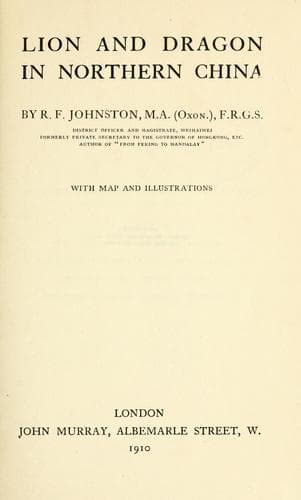
Lion and Dragon in Northern ChinaJohnston, Reginald Fleming, Sir
History
Lion and Dragon in Northern China
Johnston, Reginald Fleming, Sir
Weihai (China) -- History; Weihai (China) -- Social life and customs
Ch'i Yen-yün was a graduate and a devoted student of the art of poetry.
He put his books in a bundle and trudged away to look for a Master.
He wandered great distances, and made a pilgrimage to the Five Sacred
Mountains. He was joined by a number of disciples, who came from all
directions and travelled about with him. A pilgrimage to the Wu Yüeh
or Five Sacred Mountains,[49] it may be mentioned, is regarded as a
performance of no mean merit, through which the pilgrim will infallibly
evolve mystical or spiritual powers of marvellous efficacy. These
valuable powers have not yet shown themselves in a foreigner from
distant Europe who performed this little feat in 1908-9.
Wang Ch'i-jui was famous among all the literates of the district for
his exemplary character. When he was only thirteen he and his whole
family were bought by a certain official as domestic servants. Wang
paid the greatest attention to his studies, and his master, seeing
this, put out his tongue in astonishment and said, "this boy is much
too good to be wasted." So he cancelled the deed of purchase and set
the boy free. In after-years he distinguished himself as a friend of
the down-trodden and oppressed, and during the troublous times that
marked the end of the Ming and the rise of the Ch'ing dynasty he
strenuously advocated the cause of the poor. Once he passed a certain
ruffian who was waiting by the roadside to waylay travellers. This
man was the most truculent swashbuckler in the whole countryside; but
when he saw Wang Ch'i-jui, and recognised him, he lowered his sword.
Subsequently through Wang's clemency this robber received a pardon for
his crimes.
The name of the patriot Huang Ch'êng-tsung of the Ming dynasty is
enrolled among both the _Hsiang Hsien_ (Local Worthies) and the _Chung
Ch'ên_ (Loyal Officials). The records say that though he came of a poor
family in Weihaiwei he showed a zealous and ambitious temperament even
from the days of childhood. Having taken his degree, he was appointed
to a post at Ch'ing-tu, where he distinguished himself as an able
official. In 1638, when rebel troops were approaching the city, he
placed himself at the head of the local troops and fought with great
heroism for ten days. Unfortunately a certain military graduate entered
into traitorous communication with the enemy and let them into the
city. When Huang was told the bad news he decided that, though defeat
and death were now certain, he was bound in honour to fight to the
last. He had a brave young son of eighteen years of age, named Huang
Chao-hsüan, who, learning what had happened, addressed his father thus:
"An official can prove his loyalty by dying for his sovereign, a son
his filial devotion by dying with his father." The two went out to meet
the enemy together. Huang Ch'êng-tsung was shot dead by an arrow while
he was fighting in the streets, and the son was slain at his father's
side.
Public-domain text, read in full here on John Shaqi.
Reviews
Reviews
No reviews yet
Be the first to share your thoughts on this work.
Elsewhere in the archive
Join the Discussion
Join the discussion
Sign in to leave a comment or review.
Sign InorCreate an account