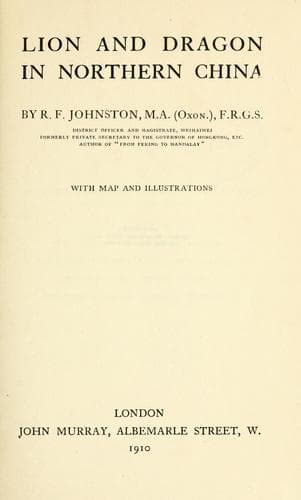
Lion and Dragon in Northern ChinaJohnston, Reginald Fleming, Sir
History
Lion and Dragon in Northern China
Johnston, Reginald Fleming, Sir
Weihai (China) -- History; Weihai (China) -- Social life and customs
When negotiations were being carried on seventy years ago for the
cession of Hongkong to the British Crown the only interests that
were properly consulted were those of commerce. Military and naval
requirements were so far overlooked that one side of the harbour,
with its dominating range of mountains, was allowed to remain in the
hands of China, the small island of Hongkong alone passing into the
hands of Great Britain. The strategic weakness of the position was
soon recognised; it was obvious that the Chinese, or any hostile Power
allied with China, could hold the island and the harbour, with its
immense shipping, entirely at its mercy by the simple expedient of
mounting guns on the Kowloon hills. The first favourable opportunity
was taken by the British Government to obtain a cession of a few square
miles of the Kowloon peninsula, but from the strategic point of view
this step was of very little use; and it was not till 1898 that the
Hongkong "New Territory"--a patch of country which, including the
mountain ranges and some considerable islands, has an area of several
hundred square miles--was "leased" to Great Britain "for a period of
ninety-nine years."
When, in the same year, arrangements were being made for the "lease"
of Weihaiwei, no decision had been come to as to whether the place was
to be made into a fortress, like Hongkong, or merely retained as a
flying base for the fleet or as a depôt of commerce: but to make quite
sure that there would be enough territory for all possible or probable
purposes the British Government asked for and obtained a lease not only
of the island of Liukung but also of a strip of land measuring ten
miles round the entire bay. The bay itself, with its various inlets, is
so extensive that this strip of land comprises an area of nearly three
hundred square miles, with a coast-line of over seventy miles; while
the beeline frontier from the village of Ta-lan-t'ou in the extreme
east to Hai Chuang in the extreme west measures about forty miles.
This land-frontier is purely artificial: in one or two cases, while
it includes one portion of a village it leaves the rest in Chinese
territory. This considerable area is under direct British rule, and
within it no Chinese official has any jurisdiction whatever except,
as we have seen,[52] within the walls of the little city from which
the Territory derives its name. Beyond the British frontier lies a
country in which the British Government may, if it sees fit, "erect
fortifications, station troops, or take any other measures necessary
for defensive purposes at any points on or near the coast of the region
east of the meridian 121° 40' E. of Greenwich." The British "sphere of
influence" may thus be said to extend from about half-way to Chefoo on
the west to the Shantung Promontory on the east: but Great Britain has
had no necessity for the practical exercise of her rights in that wide
region.
Public-domain text, read in full here on John Shaqi.
Reviews
Reviews
No reviews yet
Be the first to share your thoughts on this work.
Elsewhere in the archive
Join the Discussion
Join the discussion
Sign in to leave a comment or review.
Sign InorCreate an account