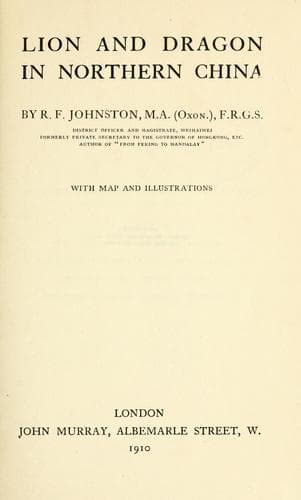
Lion and Dragon in Northern ChinaJohnston, Reginald Fleming, Sir
History
Lion and Dragon in Northern China
Johnston, Reginald Fleming, Sir
Weihai (China) -- History; Weihai (China) -- Social life and customs
Of the general appearance of the Territory and its neighbourhood
something has been said in the second chapter. Hills are very numerous
though not of great altitude, the loftiest being only about 1,700 feet
high. A short distance beyond the frontier one or two of the mountains
are more imposing, especially the temple-crowned Ku-yü hills to the
south-west, which are over 3,000 feet in height.[53] There are about
three hundred and fifteen villages in the leased Territory under direct
British rule; of these none would be described as a large village
in England, and many are mere hamlets, but they have been estimated
to contain an aggregate population of 150,000. Considering that
agriculture is the occupation of all but a small portion of the people,
and that large areas in the Territory are wholly unfit for cultivation,
this population must be regarded as very large, and its size can only
be explained by the extreme frugality of the people and the almost
total absence of a leisured or parasitic class.
The Weihaiwei Convention was signed in July 1898. For the first
few years the place was controlled by various naval and military
authorities, of whom one was Major-General Sir A. Dorward, K.C.B.,
but it can hardly be said to have been administered during that time,
for the whole Territory beyond Liukungtao and the little mainland
settlement of Ma-t'ou (now Port Edward) was almost entirely left to
its own devices. The temporary appointment of civil officers lent by
the Foreign and Colonial Offices led to the gradual extension and
consolidation of civil government throughout the Territory. One of
these officers was the late Mr. G. T. Hare of the Straits Settlements
Government, and another--whose excellent work is still held in
remembrance by the people--was Mr. S. Barton, of the British Consular
Service in China. The appointment of Mr. R. Walter[54] as Secretary
to Government shortly preceded that of Mr. (now Sir) J. H. Stewart
Lockhart, Colonial Secretary of Hongkong, as first civil Commissioner.
Public-domain text, read in full here on John Shaqi.
Reviews
Reviews
No reviews yet
Be the first to share your thoughts on this work.
Elsewhere in the archive
Join the Discussion
Join the discussion
Sign in to leave a comment or review.
Sign InorCreate an account