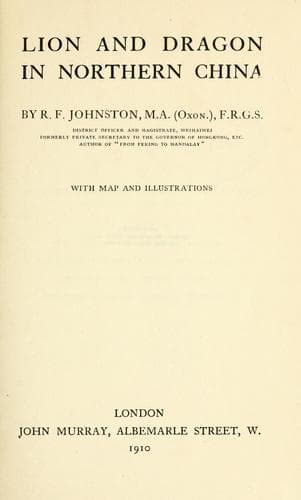
Lion and Dragon in Northern ChinaJohnston, Reginald Fleming, Sir
History
Lion and Dragon in Northern China
Johnston, Reginald Fleming, Sir
Weihai (China) -- History; Weihai (China) -- Social life and customs
To persuade them to fight against China would necessarily have
become more and more difficult as the Chinese Empire proceeded in
the direction of reform and enlightenment. The Boxers, indeed, were
theoretically regarded as rebels against China, so that Chinese troops
in British pay could fight them with a clear conscience, believing
or pretending to believe that they were fighting for the cause of
their own Emperor as well as (incidentally) that of Great Britain.
But the Regiment outlived the Boxer movement by several years, and
the maintenance of a considerable body of troops (at an annual cost
to the British taxpayer of something like £30,000) with a sole view
to the possibility of a similar rising at some uncertain date in the
future was hardly consistent with British common sense. Moreover, its
position in the event of an outbreak of regular warfare between England
and China would have been peculiar in the extreme, inasmuch as the
men had never been required, under the recruiting system, to abjure
their allegiance to the Chinese Emperor. They were, in fact, Chinese
subjects, not British. Even over the inhabitants of Weihaiwei, from
whom a small proportion of the men was drawn, the Emperor of China
retains theoretical sovereignty. This has been expressly admitted by
the British Government, which has declared that as Weihaiwei is only a
"leased territory," its people, though under direct British rule, are
not in the strictly legal sense "British subjects."[57]
The officers of the Regiment would no doubt have denied that the
loyalty of the men to their British leaders was ever likely to fall
under suspicion, but the fact remains that in the event of an outbreak
of regular warfare between China and Great Britain the Chinese
authorities might, and probably would, have done their utmost to induce
the men of the Regiment to desert their colours and take service
with their own countrymen. Many methods of inducement could have
been employed, over and above the obvious one of bribery. It is only
necessary to mention one that would have been terribly forcible--the
imprisonment of the fathers or other senior relatives of the men who
refused to leave the British service, and the confiscation of their
ancestral lands. The men who deserted, in these circumstances, would
not, perhaps, feel that they had much to reproach themselves with. They
had taken service under the British flag: but did that entitle them to
become traitors to their own country, and to violate the sacred bonds
of filial piety? Even if the Chinese soldier in British employment
had been formally absolved from all allegiance to his own sovereign
it would have been unreasonable to expect him to evolve a spirit of
loyalty to a European monarch of whose existence he had but the vaguest
idea, and to whom he was bound by no ties of sentiment.
Public-domain text, read in full here on John Shaqi.
Reviews
Reviews
No reviews yet
Be the first to share your thoughts on this work.
Elsewhere in the archive
Join the Discussion
Join the discussion
Sign in to leave a comment or review.
Sign InorCreate an account